Connectors Terminals
This category covers the fundamental building blocks of audio connections: the plugs, jacks, and terminals used to terminate cables and build equipment. High-quality connectors, such as banana plugs and spades for speaker wire or robust RCA plugs, ensure a secure, low-resistance electrical contact that is vital for signal integrity. This guide is a resource for DIY builders and tweakers, listing the brands that manufacture these essential audio hardware components.
Hi-Fi brands in the category
Summary information and image
Direct links to official websites
Analysis Plus
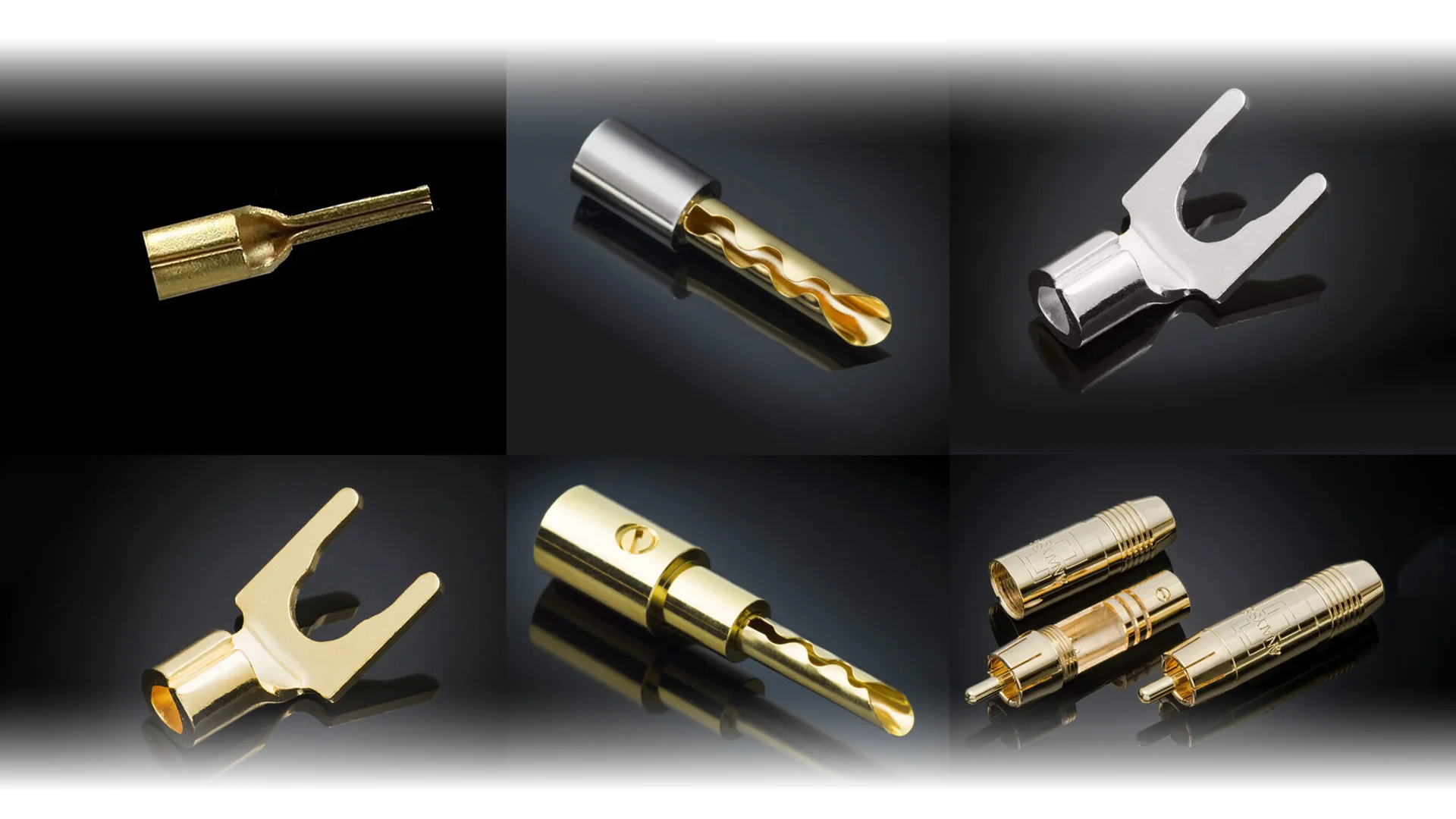
Analysis Plus designs cables around a hollow oval conductor geometry, developed through electrical modelling rather than the conventional assumption that a round conductor is the obvious starting point. Founded in 1993 as a research and design company, the American business is associated with engineer Mark Markel. Its Hollow Oval approach is intended to address how current distributes through a conductor as frequency changes. The catalogue spans home-audio connections and professional instrument cables, linking hi-fi systems with the recording and performing side of music. Speaker cables and interconnects sit alongside power and digital connections, with different conductor materials and constructions across the range.
Atlas

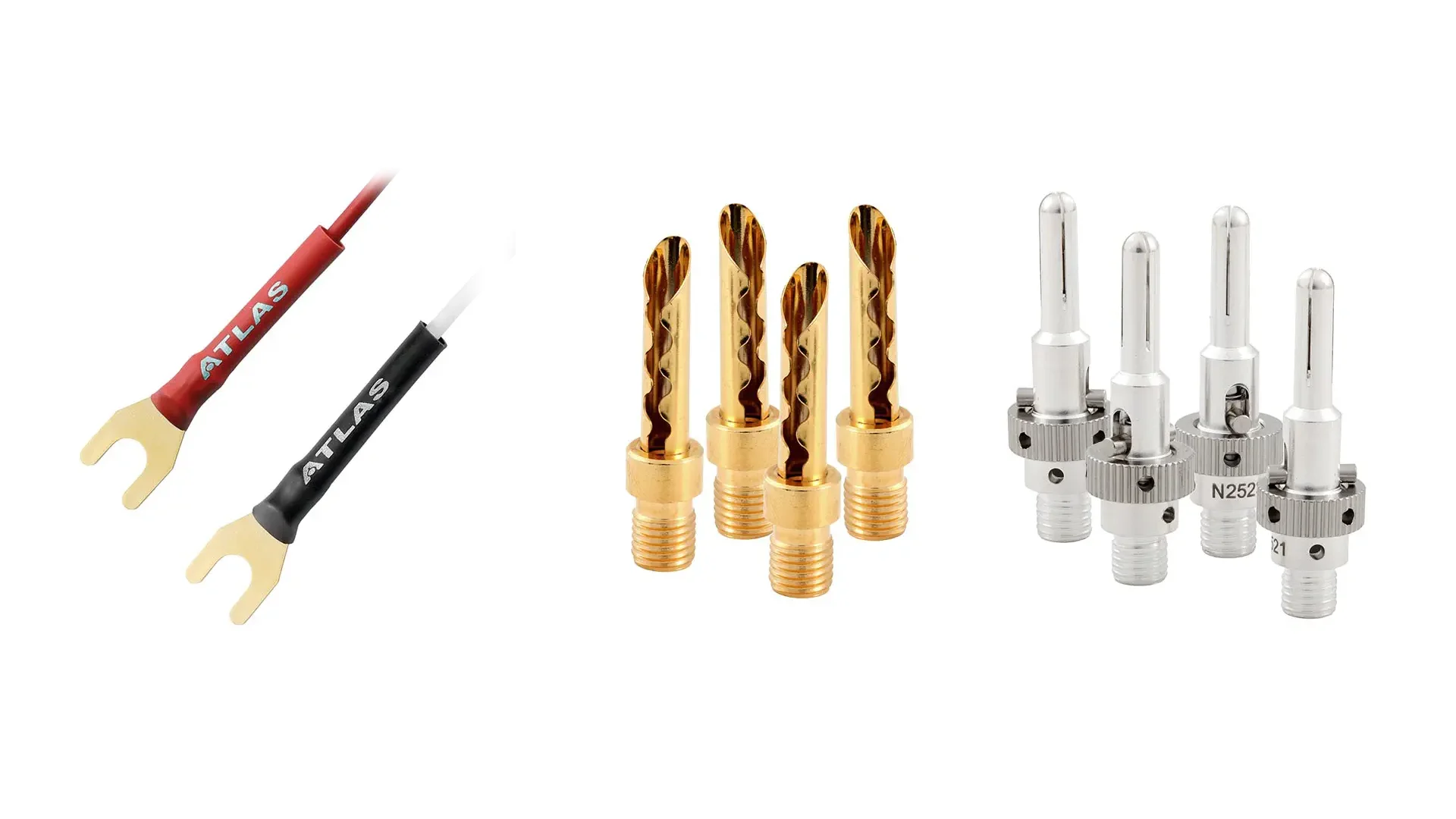
Atlas Cables designs and hand-builds audio connections in Kilmarnock, Scotland, with attention to the connector as well as the cable itself. The brand began in 2000 and spans analogue interconnects, speaker cables, digital links and power products. Equator, Hyper and Mavros are among its established families, with different conductor, dielectric and termination choices across the range. A practical distinction is the factory’s support for existing cables: selected products can be reconditioned, reterminated, fitted with newer connectors or converted to support Atlas’s Grun system. Custom lengths and this ability to repair or repurpose a cable make the manufacturing operation relevant well after the initial purchase.
Atohm

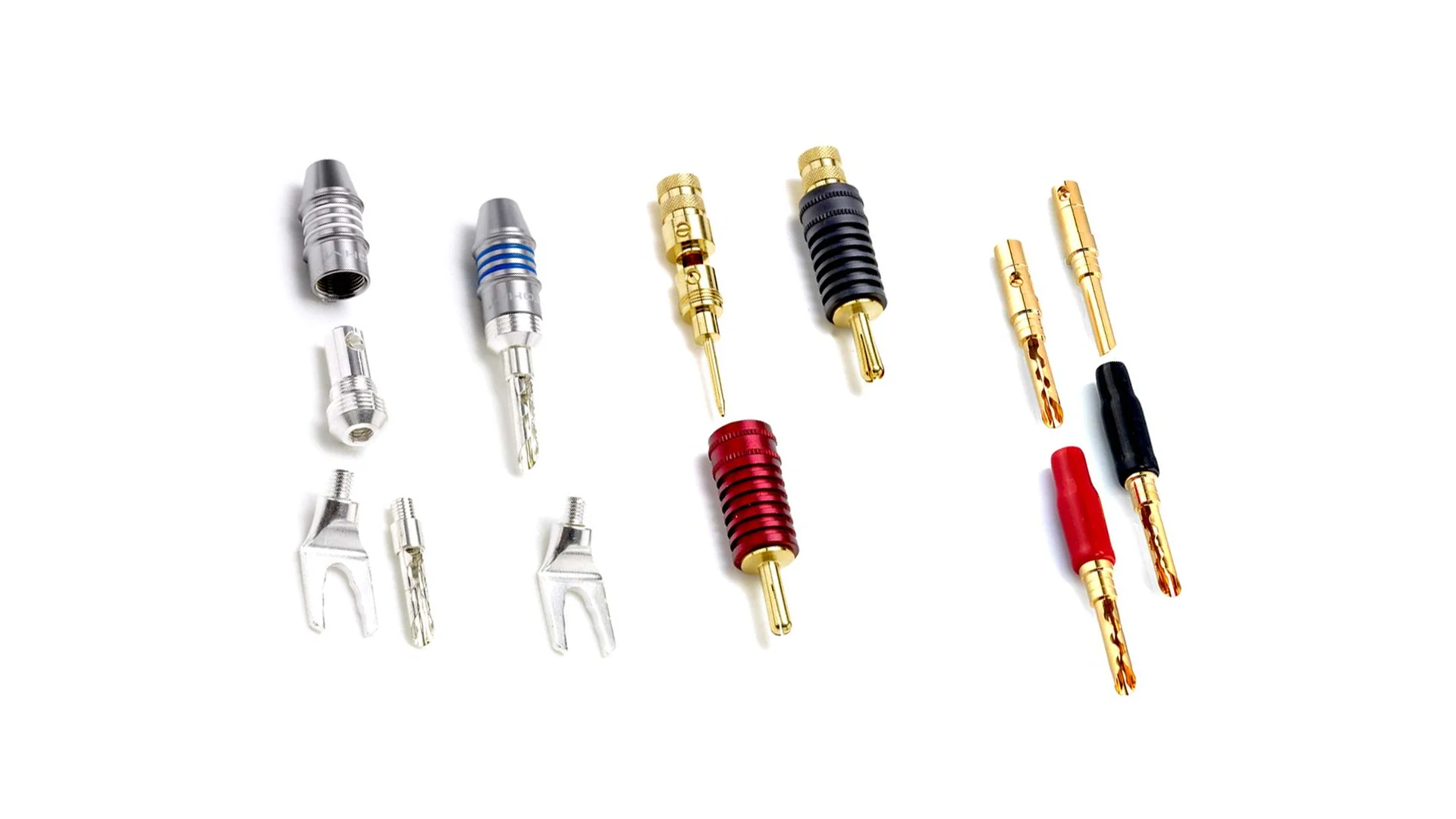
Atohm develops the drive units as well as the finished loudspeaker, and also supplies drivers and kits to people building their own systems. Thierry Comte established the French business behind the brand, Welcohm Technology, in 2000. Its catalogue connects GT and Sirocco loudspeakers with Rafale subwoofers, amplification and ZEF cables. The GT technical platform illustrates the detail of its driver engineering: the Absolute Series tweeter combines a treated silk dome, a neodymium motor and a copper ring intended to reduce and linearise inductance. Motor geometry and dispersion are developed together with the diaphragm and suspension. The same engineering interests extend into its component and DIY offerings.
Black Rhodium
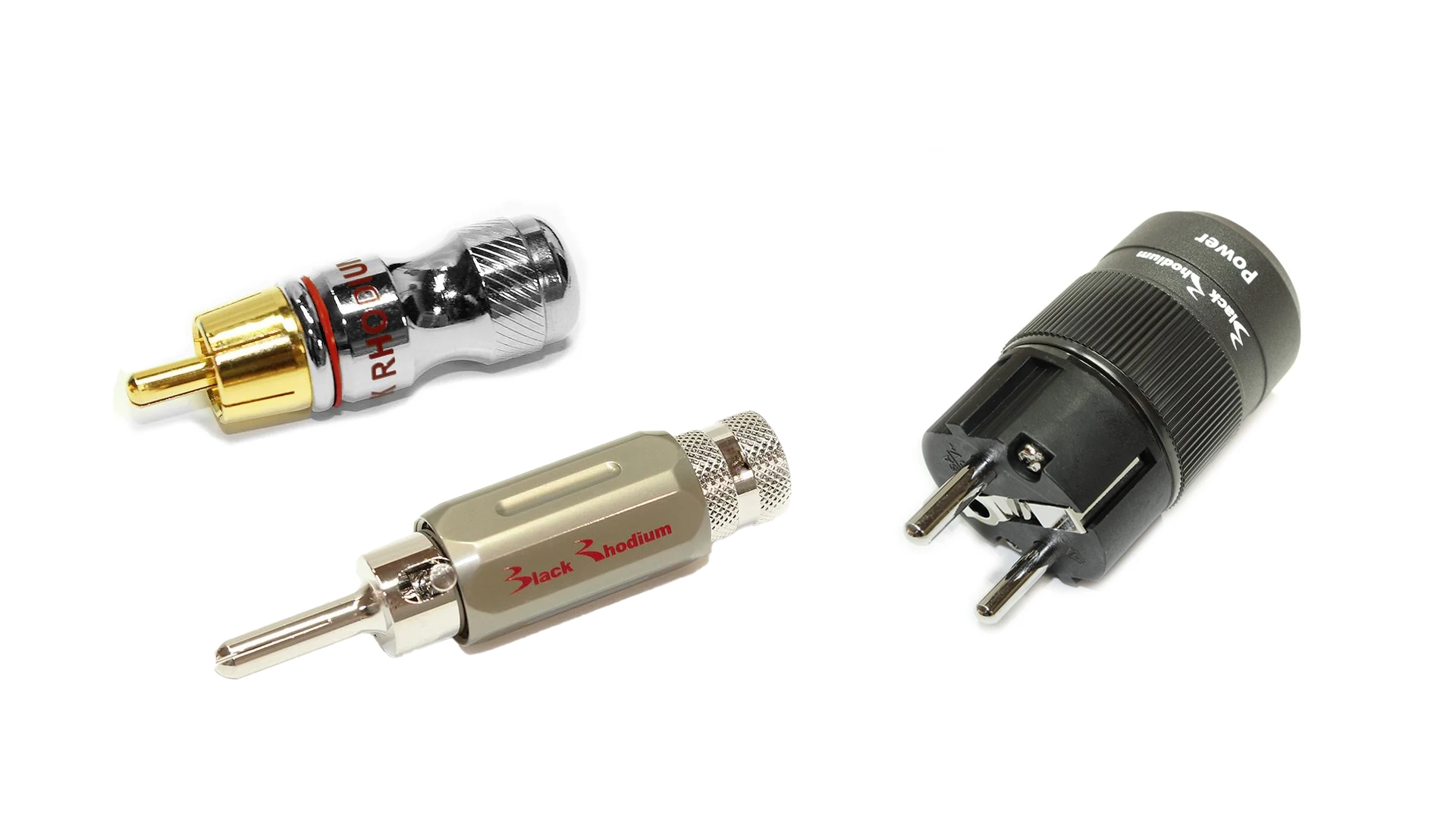
Black Rhodium is a British cable specialist founded by engineer Graham Nalty in Derby in 2002. Its range covers analogue interconnects, loudspeaker cables, mains leads, digital connections and specialist headphone and tonearm wiring, allowing complete systems to be cabled within one design family. Rather than relying on one conductor for every application, the company varies conductor material and gauge, dielectric, geometry, shielding, connector choice and mechanical damping according to the signal or power role. Products range from accessible assembled cables to more elaborate designs using silver conductors, low-loss insulation and additional vibration control. Black Rhodium’s value is this application-specific approach and long continuity under its founder, not a promise that one material automatically suits every system. The previously missing foundation year has been filled with the documented date 2002.
Cardas
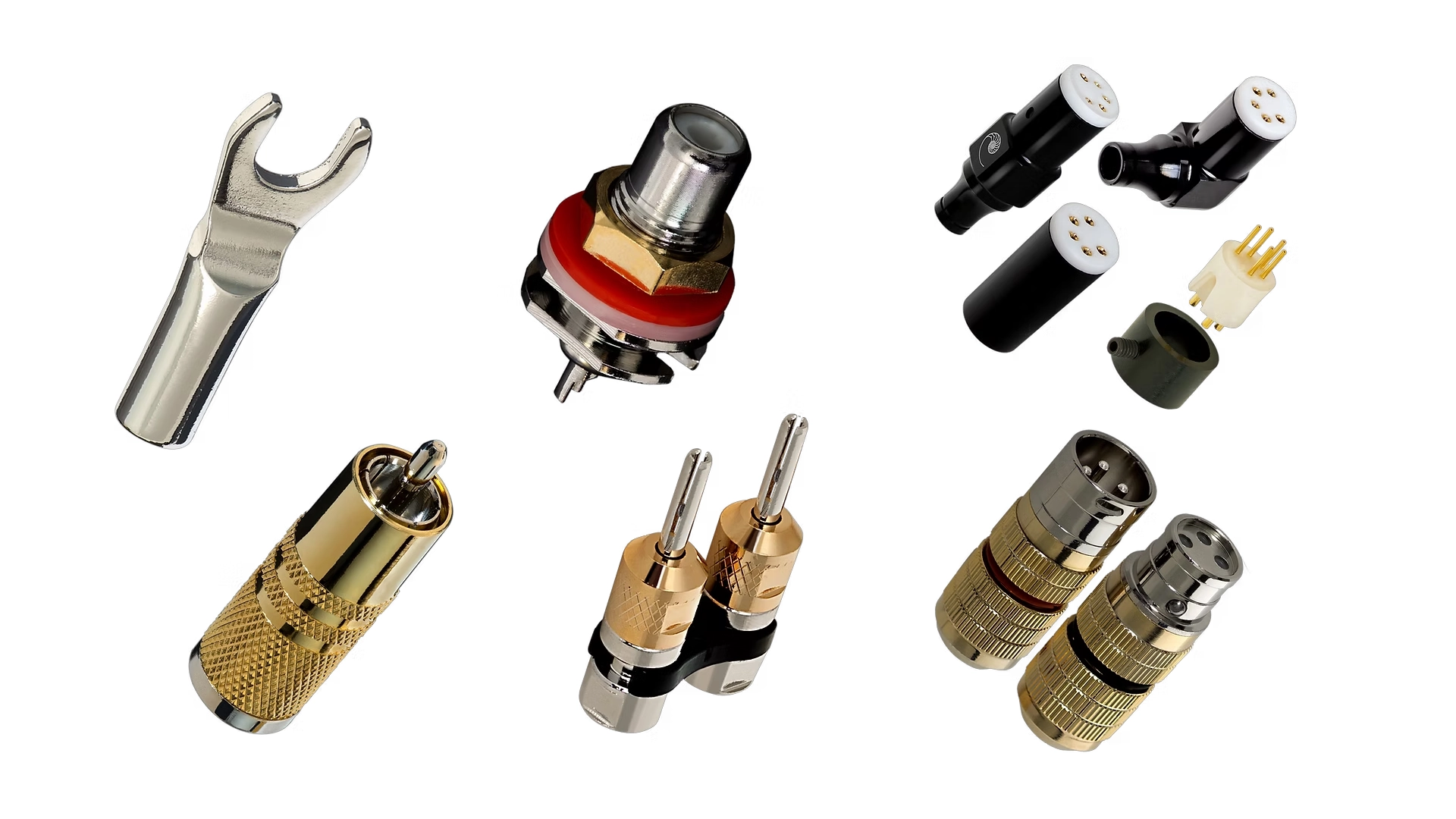
Cardas Audio controls cable behaviour by designing and manufacturing the conductor itself, not only its outer geometry and connectors. Former telephone transmission engineer George Cardas founded the company in Ontario, California, in 1987 and moved it to Bandon, Oregon, in 1992. His patented Golden Section stranding arranges progressively sized conductors according to the golden ratio to spread mechanical and electrical resonances. Each fine strand is individually enamelled in a Litz construction, limiting oxidation and interaction between strands. Later Matched Propagation designs coordinate conductor and dielectric behaviour throughout the Clear range. Cardas produces its own ultra-pure copper conductors and also makes interconnects, speaker and power cables, bulk wire, solder, binding posts, RCA, XLR, DIN and headphone connectors for manufacturers and DIY builders. George remains head designer, while his daughter Angela manages the company.
Ethereal
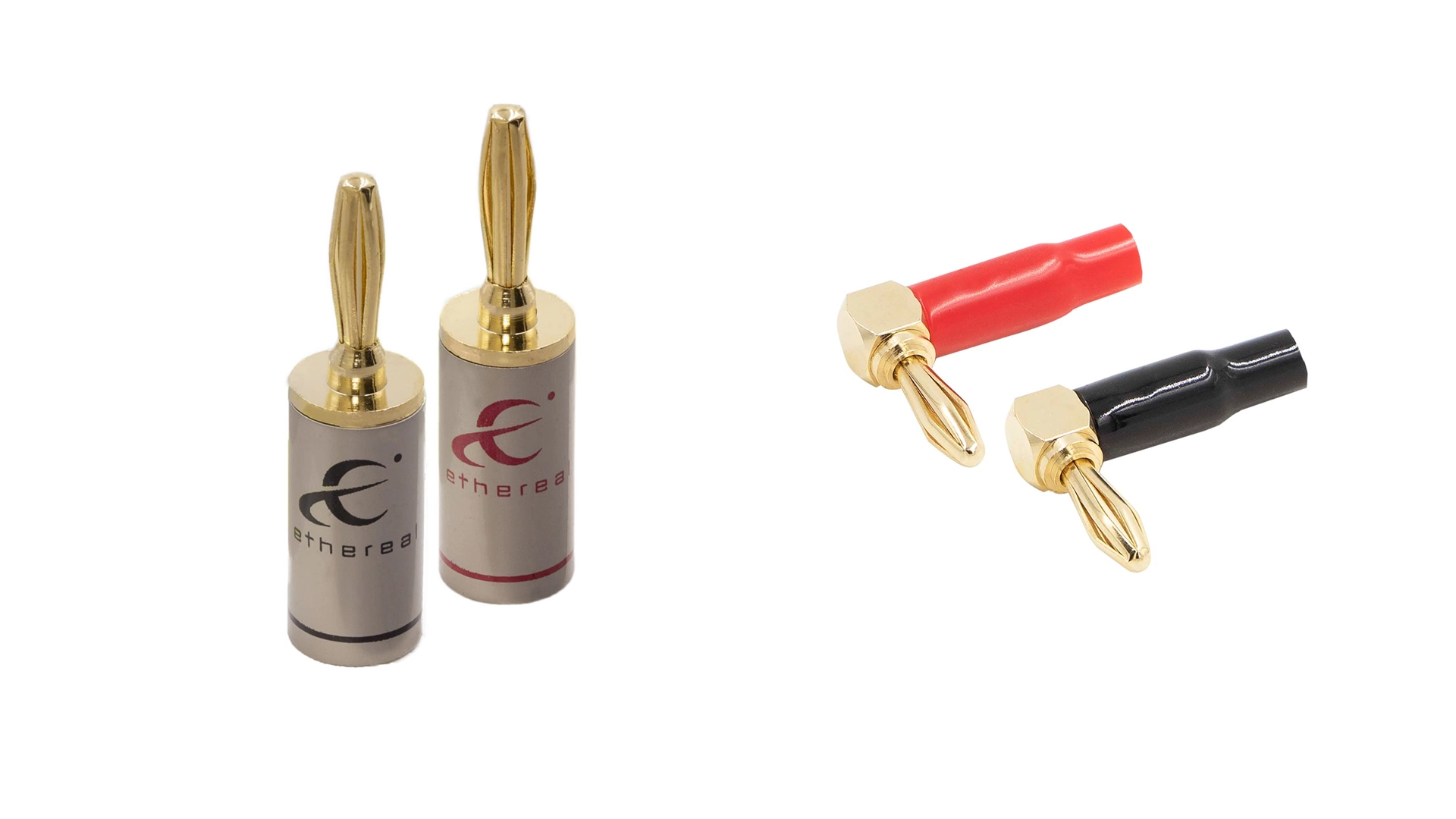
Ethereal is the American custom-installation connectivity business created by Metra Electronics as Ethereal Home Theater in 2001. The operation later traded as MetraAV and returned to the Ethereal name in 2023, bringing Ethereal Home Theater, Velox, Helios and Big Dog Power under one identity. Its core work is practical AV infrastructure: certified copper and active-optical HDMI cables, extenders, splitters, adapters, wall-plate hardware, audio interconnects, speaker cable and power-distribution products for residential and commercial systems. The engineering focus is reliable high-bandwidth signal delivery over real installation distances and diagnostic solutions for HDMI handshaking, power and compatibility problems. Ethereal is not an audiophile cable boutique; it is a Florida-based integration supplier built around standards compliance, field troubleshooting and the less visible connections that determine whether an AV system works consistently.
Furutech
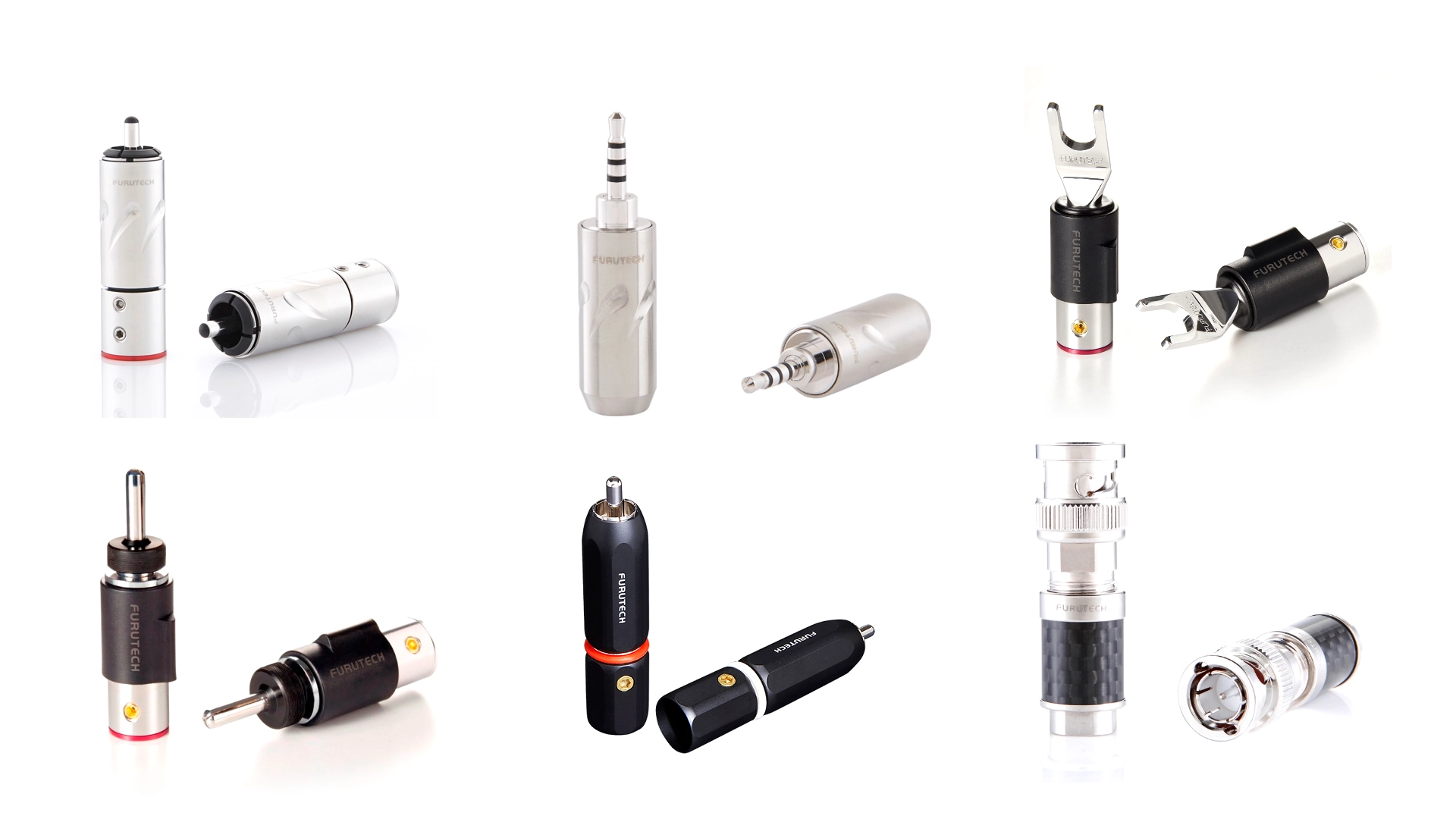
Furutech is a Japanese specialist in the physical interfaces of an audio system: plugs, sockets, terminals, power distribution and finished signal or power cables. Founded in 1988, the company applies its two-stage Alpha Process to many metal parts, combining deep cryogenic treatment with ring demagnetisation before assembly and plating. Its catalogue reaches from IEC, mains and XLR/RCA connectors to wall outlets, power distributors, bulk cable, phono accessories, record clamps and static-elimination devices. Nano Crystal² Formula, or NCF, appears in selected connector bodies and support accessories, where a composite of damping and electrostatic-control materials is used to address vibration and static charge around a contact. Furutech also develops Piezo Ceramic housings, floating-field structures and cable supports rather than treating the conductor as the only variable. The breadth matters: engineers, installers and DIY builders can specify individual parts, while listeners who do not assemble cables can choose complete Evolution, Lineflux, Powerflux and NanoFlux products.
Gotham

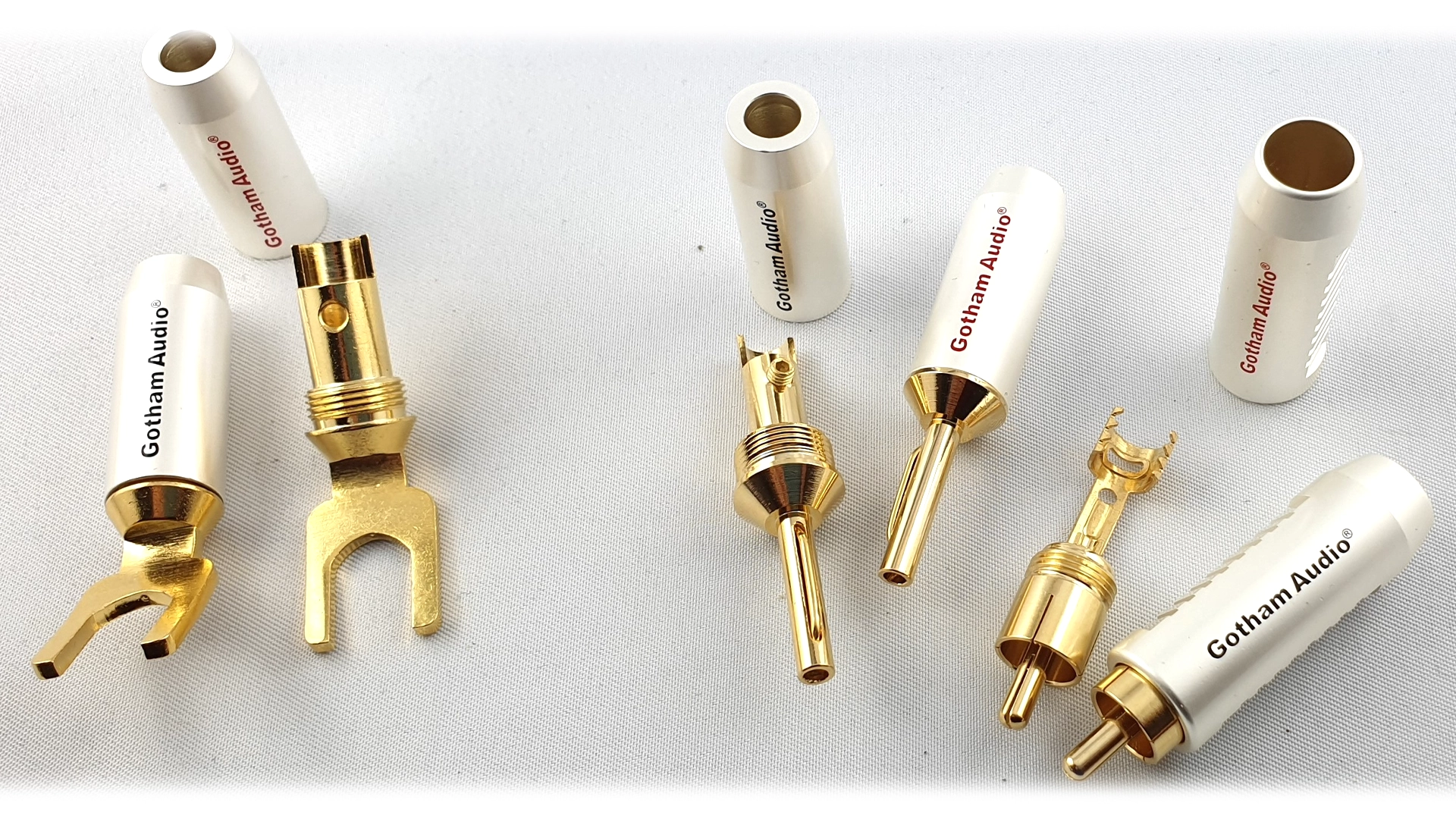
Gotham is a Swiss cable company whose reputation was built in studios, broadcast facilities and installed sound rather than in decorative consumer accessories. Operating since 1958 and now based in Dietikon as Gotham AG, it supplies both bulk cable and finished assemblies. The catalogue includes microphone and star-quad lines, analogue multicore, AES/EBU and DMX cable, loudspeaker and mains cable, video, data and internal hook-up wire. Dense copper coverage, flexible jackets, clearly documented electrical specifications and application-specific geometries are recurring priorities, because the same cable may need to survive touring, permanent installation or low-level studio signals. Gotham also manufactures terminated cables in Switzerland and offers many formats by the metre. Its principal strength is a broad, technically coherent professional range that can connect an entire audio infrastructure.
Harmonic Technology
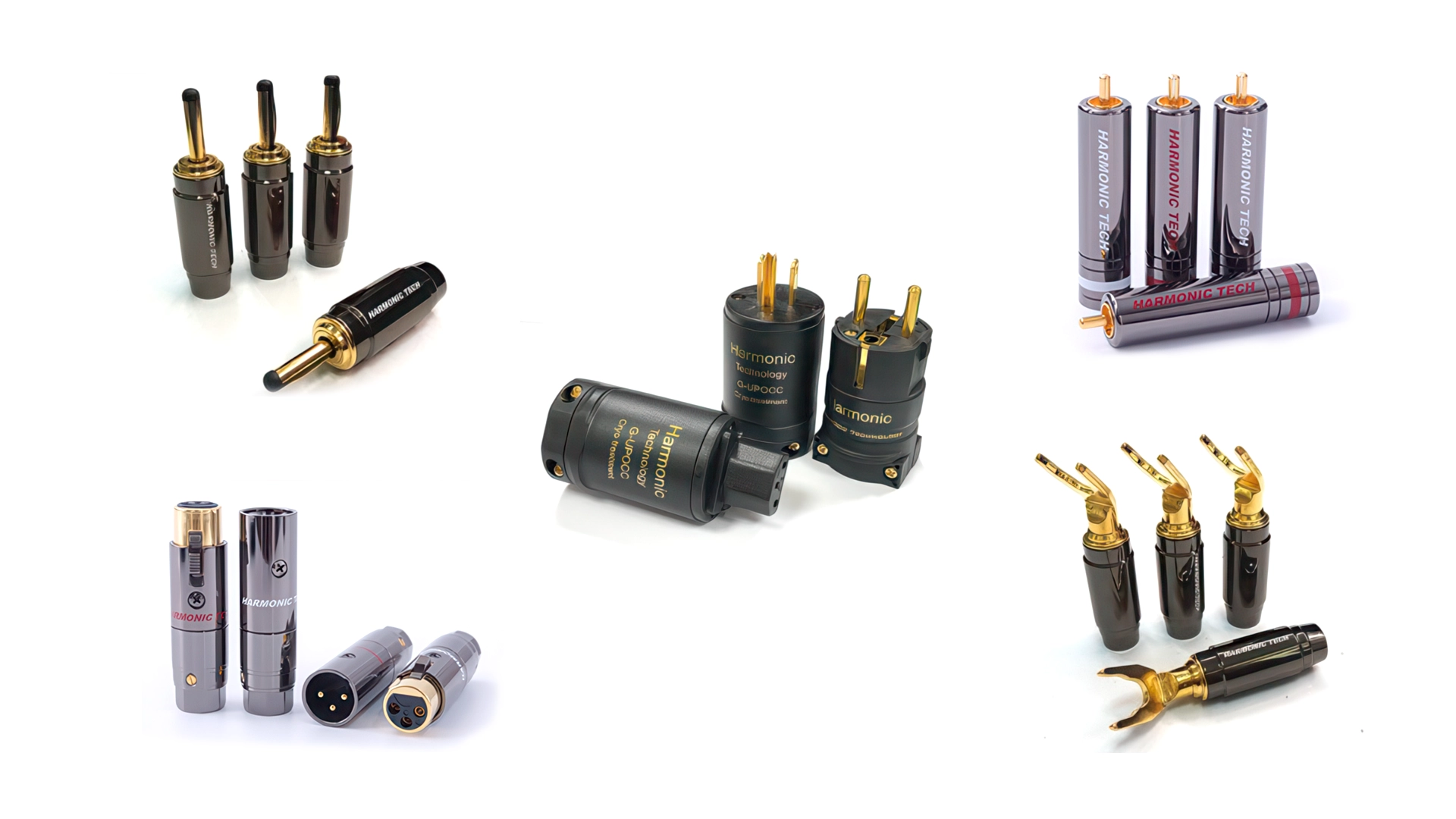
Harmonic Technology is an American cable specialist founded in 1998 by Jim Wang, with engineer Robert Lee among the company’s early principals. Its reputation was built around Ohno Continuous Casting conductors: unusually long-crystal copper and silver intended to reduce the boundaries found in conventional drawn wire. The company does not treat conductor purity alone as a complete cable design. Its products combine selected OCC metals with individually insulated strands or solid conductors, controlled geometry, dielectric materials, shielding and termination methods chosen for speaker, analogue, digital and mains applications. Families such as Melody, Pro, Magic and the rectangular-conductor RecTa range show how the same materials platform is adapted at different levels rather than repeated under new names. Harmonic Technology’s distinctive contribution is therefore materials-led cable engineering, especially the long-running use of single-crystal copper and silver across a broad system loom.
Mundorf

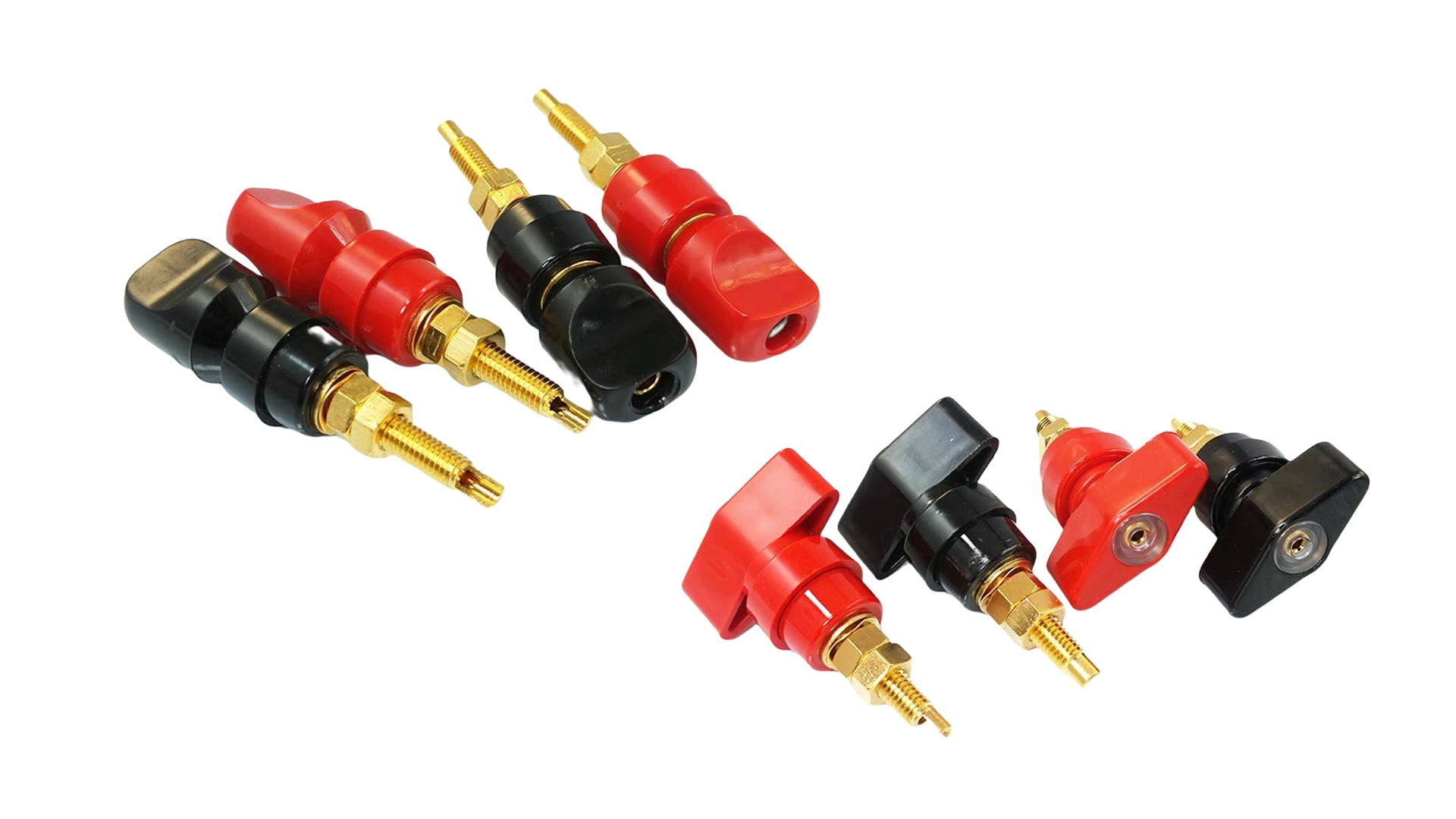
Mundorf is the German component specialist whose capacitors, coils, resistors and tweeters sit inside many loudspeakers and amplifiers sold under other names. Raimund Mundorf began offering high-quality crossover parts to hi-fi enthusiasts in 1985, turning a personal interest in improving loudspeakers into an engineering and manufacturing business in Cologne. The company remains closely identified with the MCap family of film capacitors and with custom crossover production. Its catalogue includes polypropylene and foil capacitors, air-core and ferrite-core inductors, metal-oxide resistors, terminals, internal wiring, solder, power-supply capacitors and Air Motion Transformer tweeters. Foil-coil geometries, carefully controlled winding, impregnation and contact methods are used to reduce unwanted series resistance, inductance and mechanical effects; materials and construction vary clearly across the EVO, Supreme and other lines. Mundorf also develops complete crossovers and hand-built assemblies for manufacturers. The brand’s value is unusually concrete: it supplies the passive parts that determine filter accuracy, power handling and long-term reliability, while offering designers a wide ladder of dimensions and electrical characteristics rather than one universal “audiophile” recipe.
Neotech
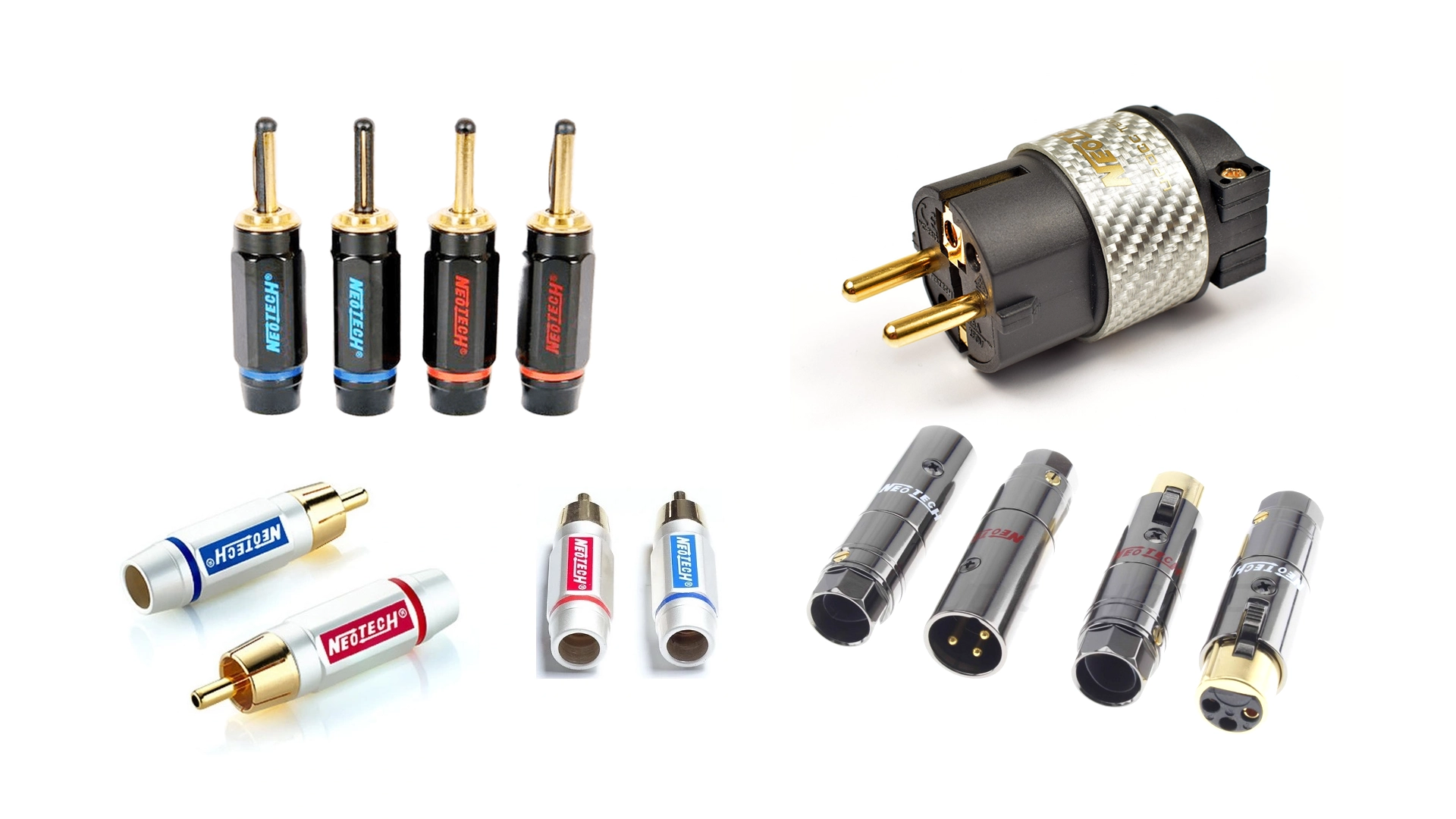
Neotech is the specialist audio-cable brand of Taiwan’s Wan Lung Electric Wire & Cable, a manufacturer established in 1980. The Neotech marque itself appeared in 1988, which is the more accurate date for the brand field. Its importance comes from conductor production as much as finished cable assembly: Wan Lung is a licensed user of Professor Atsumi Ohno’s continuous-casting process and supplies both its own ranges and OEM customers. UP-OCC—Ultra-Pure Ohno Continuous Casting—forms copper or silver with exceptionally long crystal structure and far fewer grain boundaries than conventional drawn wire. Neotech applies it in solid-core, stranded and rectangular conductors, pairing the metal with insulation and geometry chosen for analogue interconnects, speaker cables, mains leads, digital links and internal wiring. The catalogue also includes RCA, XLR, banana, spade and power connectors, enabling builders to use the same conductor system in finished or DIY assemblies. Not every Neotech product uses identical purity, plating or geometry, so those claims belong at model level. What distinguishes the company is its vertical position in the chain: it is not merely terminating bought-in wire, but drawing and processing high-purity conductors for its own cables while serving other audio brands as an OEM supplier.
Oehlbach

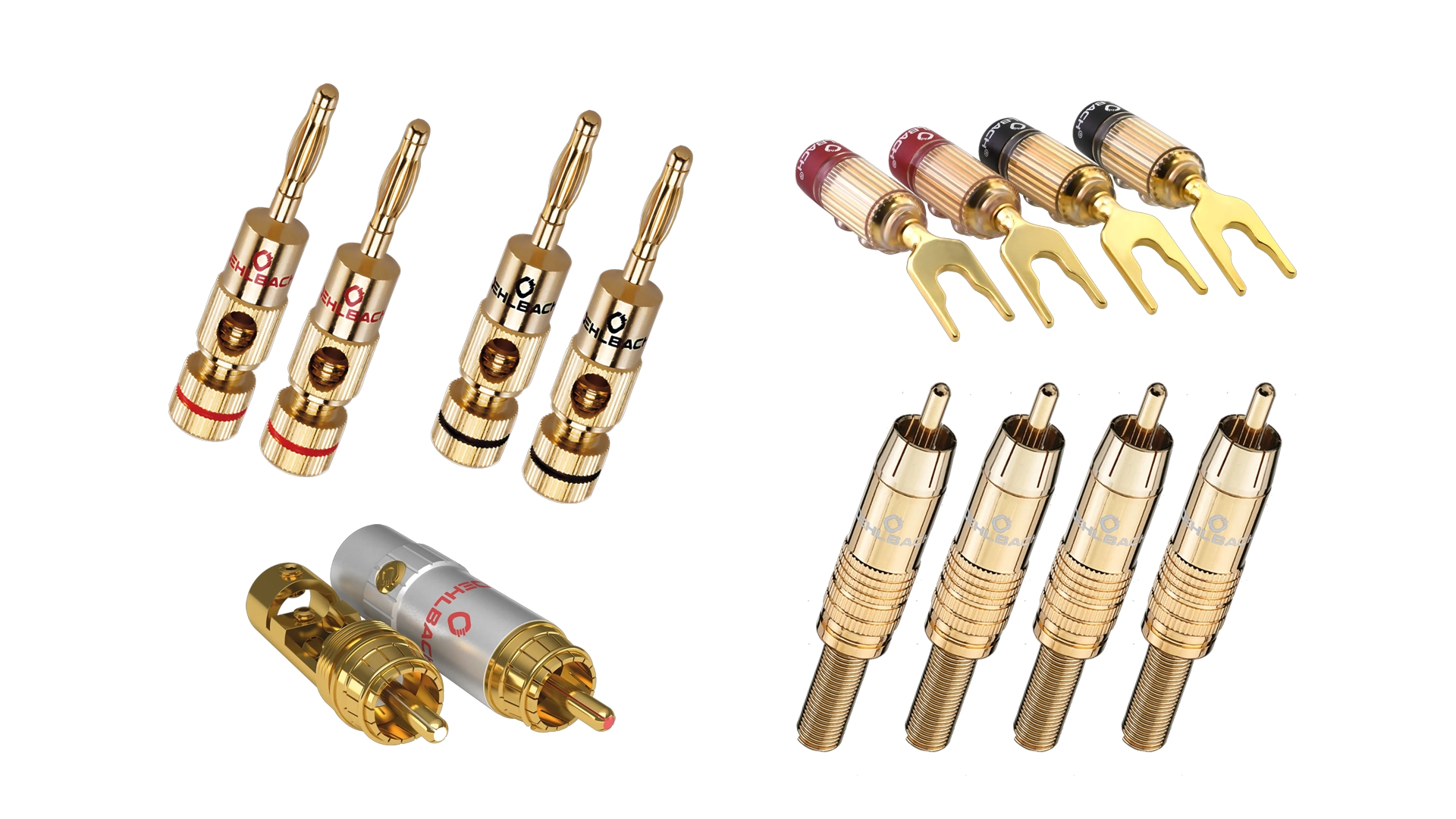
Oehlbach is the German connectivity specialist that helped turn cable construction into an explicit part of a hi-fi system. Manfred Oehlbach founded the business in 1974 after developing an early loudspeaker cable that used different conductor cross-sections for low and high frequencies. From that beginning the company expanded into one of Europe’s broadest catalogues of audio, video, data and power connections. The range now covers speaker cable, RCA and XLR interconnects, optical and coaxial digital links, HDMI, USB and network cables, antennas, mains distribution, phono accessories, adapters and connectors. Four quality levels—Easy Connect, Performance, Excellence and State of the Art—make the catalogue easier to match to an installation without pretending that every product uses the same materials. Depending on the model, Oehlbach employs high-purity copper, silver plating, defined impedance, multi-layer shielding and purpose-made plugs; its XXL and NF families are among the recognisable premium lines. The company’s strength is practical system coverage: it can connect a turntable, television, network streamer, amplifier and loudspeakers with products designed around the electrical and mechanical demands of each interface. That breadth, backed by a continuous German brand history since 1974, is more meaningful than sweeping claims that one cable recipe improves every signal.
Sine
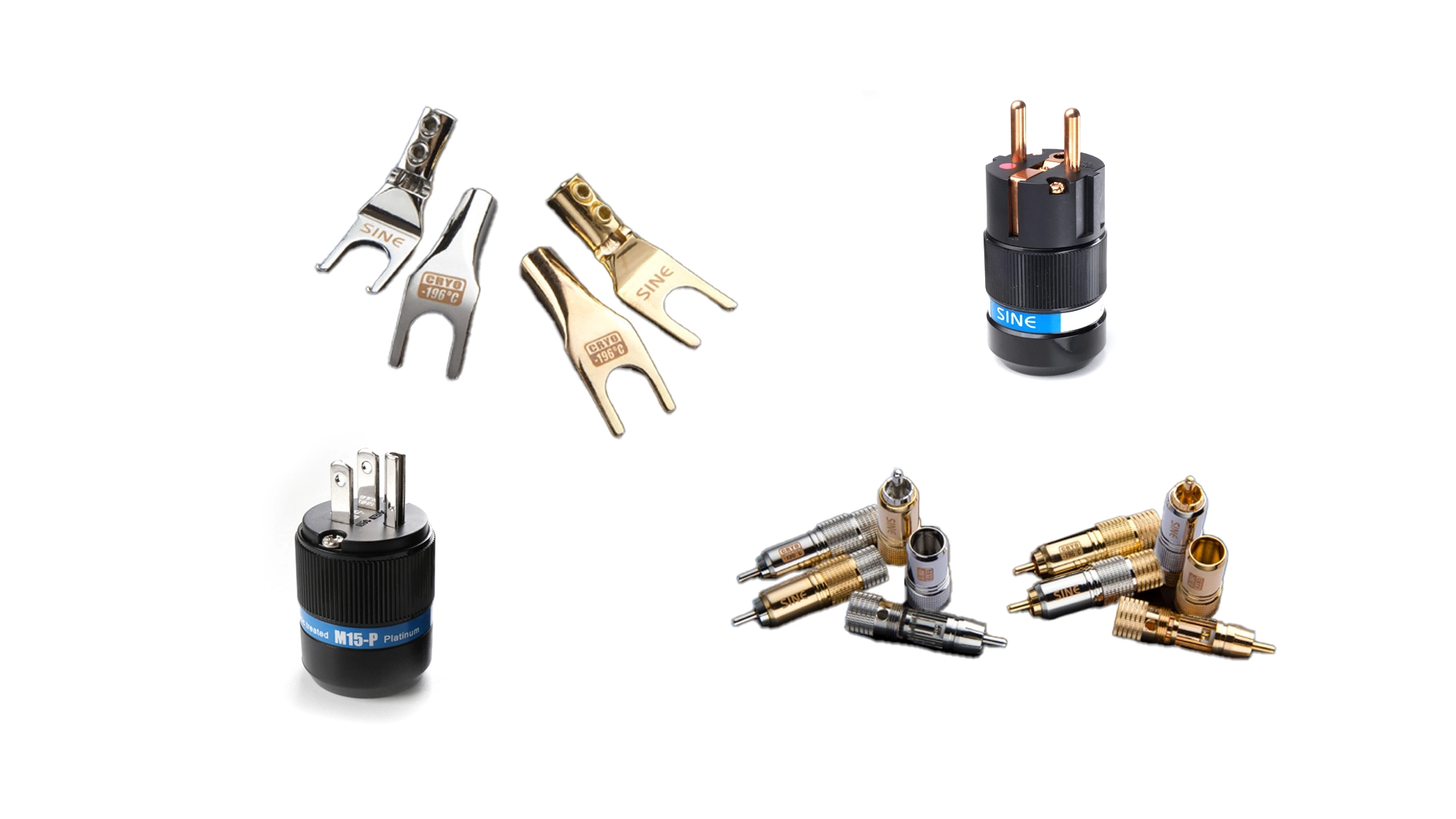
SINE is a Hong Kong high-end specialist in AC power products and audio cabling. It began from an audiophile founder’s concern with the electrical supply feeding an entire system and now operates under MIC Audio Group. The range is broader than power cords alone: conditioners, isolation transformers, voltage regulators, power distributors and wall outlets sit beside analogue interconnects, loudspeaker, digital and bulk cables. Current products include MC-series conditioners, S-series distribution and power components, and cable families such as Lineverse, Miniverse and Louis. This lets SINE address high-current amplifiers, delicate sources and low-level signals with different geometries and filtering rather than applying one construction everywhere. The most recognisable process is CRYO-196, a computer-controlled cycle that cools selected conducting materials to –196 °C, holds them at temperature and returns them slowly to ambient conditions. SINE states that the treatment relieves internal stresses and improves conductor consistency; such performance claims should be evaluated in context, but the treatment itself is a defined 48-hour manufacturing step rather than an undefined “cryogenic” label. Products also use screened structures intended to limit EMI/RF pickup, aircraft-grade metals in selected parts, and platinum- or gold-plated contacts. Recent MC30 and MC40 conditioners use dual filtration and parallel conductor paths with the aim of reducing noise without starving connected equipment of current. SINE’s identity is a system-level view of electricity: socket, protection, filtering, grounding, conductor and connector are treated as linked parts. No reliable public founding year was found, so the date remains blank rather than turning marketing history into a false precision.
Speaker Snap

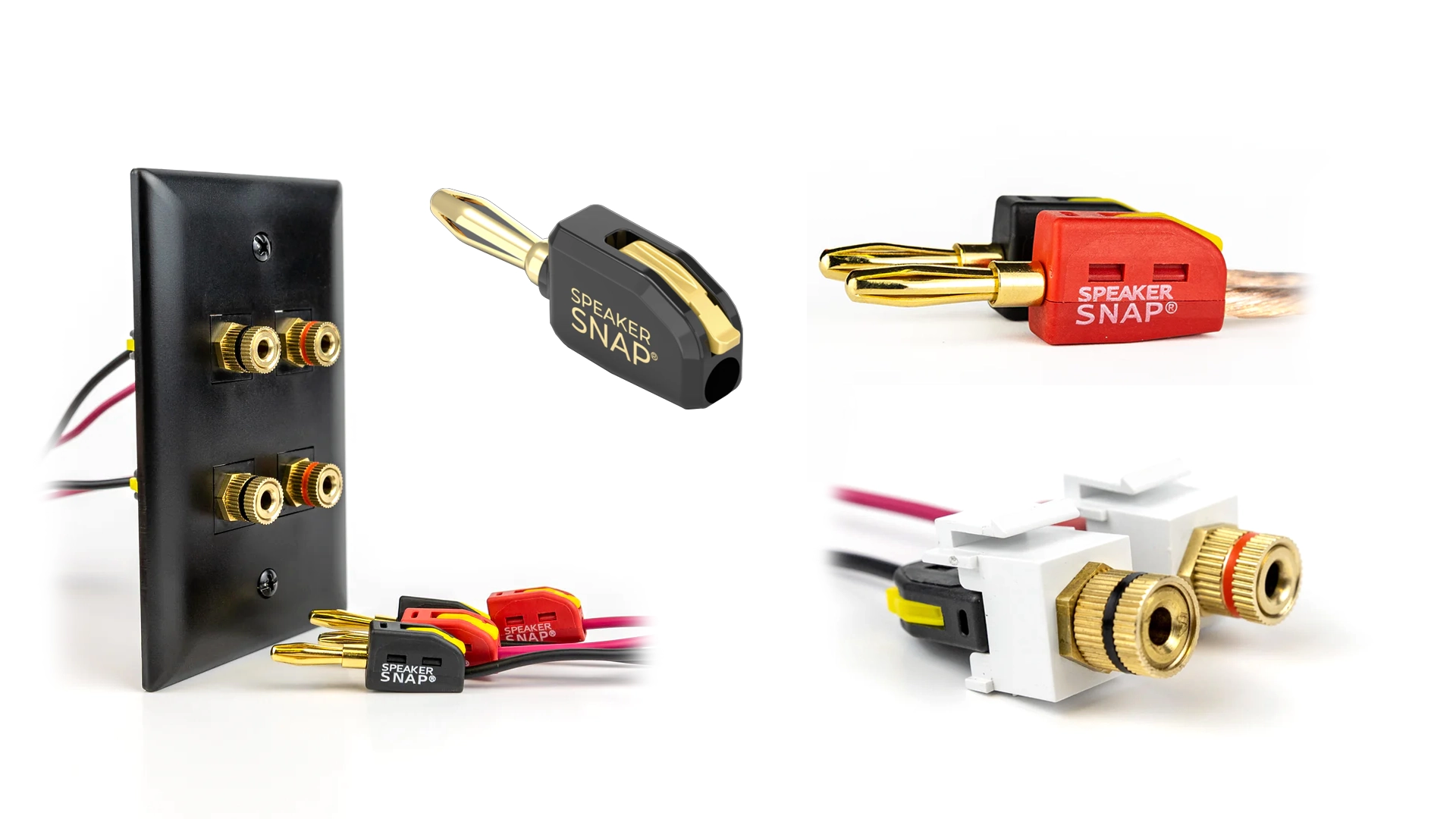
Speaker Snap makes audio cable connectors with a lever-operated locking mechanism, allowing stripped speaker wire to be secured without soldering or tightening a small screw. Its banana plugs bring that idea to the connections between an amplifier, loudspeaker and wall plate. The wire is inserted into the rear of the connector and the lever is closed to clamp it in place; the plug then fits the corresponding audio terminal. The standard banana design uses gold-plated contacts and accepts wire sizes from 12 to 24 AWG. This makes the same connector useful across a range of domestic and installation cables. The catalogue extends the approach through premium banana plugs, white and black keystone inserts, PHX connectors, a Zone Hub, an Outdoor Junction Kit and a Structured Wire Interface. These are products for wiring an audio system, with particular relevance where an installer has many connections to terminate and organise. The patented locking arrangement is the central feature, and the brand presents the installation sequence directly rather than requiring a specialist termination tool. Its products serve domestic and professional audio installations. Speaker Snap’s speciality is therefore specific: it makes the physical connection of speaker wiring quicker and easier to manage.
Straight Wire
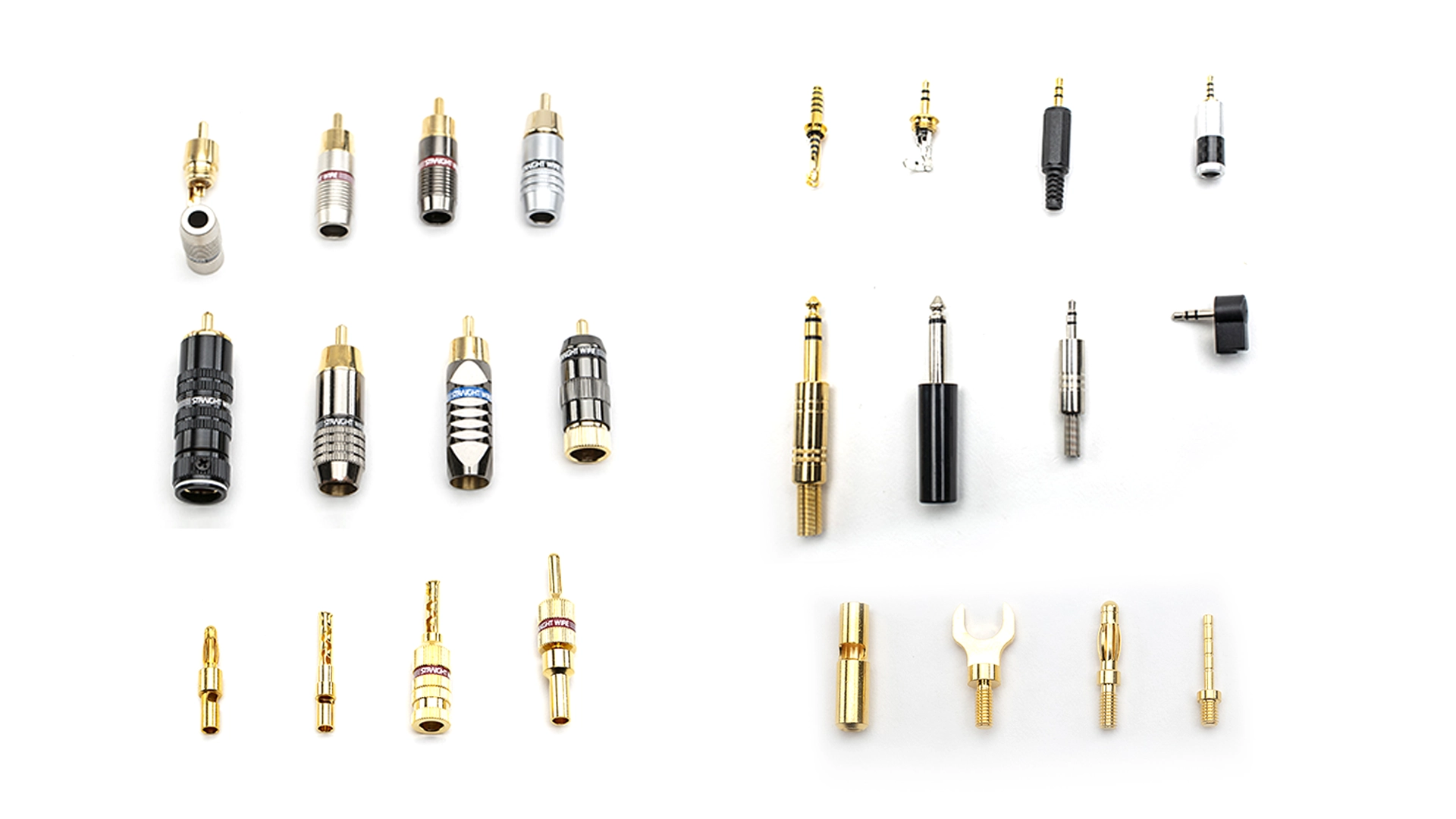
Straight Wire is a Florida cable manufacturer founded by Steven Hill in 1983, not 1980 as previously listed. Hill entered the field when specialist audio cables were still regarded by many buyers as an unfamiliar category, and the company built its reputation through clearly tiered products for stereo, home cinema and professional installation. Its catalogue covers analogue interconnects, loudspeaker cables, digital audio, HDMI and power connections, with bulk cable and termination services for custom projects. The familiar Level system groups products by construction and intended system context instead of asking a buyer to decode every material claim from scratch. Long-running names such as Rhapsody, Virtuoso and Crescendo mark successive steps in the audio range, while entry-level families provide practical lengths and terminations for less elaborate systems. Straight Wire varies conductor gauge and geometry, insulation, shielding and connector design according to the electrical job. The company also developed its Push-Prong banana connector to make field termination easier and more repeatable. Manufacturing and custom assembly in South Florida allow unusual lengths, bi-wire configurations and installation requirements to be handled without reducing the catalogue to packaged retail cables. Straight Wire’s lasting strength is this combination of engineering variety and practical guidance: it treats a phono signal, line-level interconnect, loudspeaker run and video connection as different problems, then offers a consistent way to specify, terminate and integrate them within one system.
Taga Harmony


TAGA Harmony is a company specializing in loudspeakers, audio electronics, and cables, known for its focus on providing high-quality sound at accessible price points. While having European roots, the company has significant operations and design influence from Japan. TAGA Harmony offers a wide range of products, including floor-standing speakers, bookshelf speakers, center channel speakers, subwoofers, integrated amplifiers, and various cables. Their products often feature a modern aesthetic and are designed to deliver a balanced and engaging sound. The company’s design philosophy emphasizes a combination of engineering principles and subjective listening evaluations to achieve optimal performance. TAGA Harmony products are positioned in the
Transparent

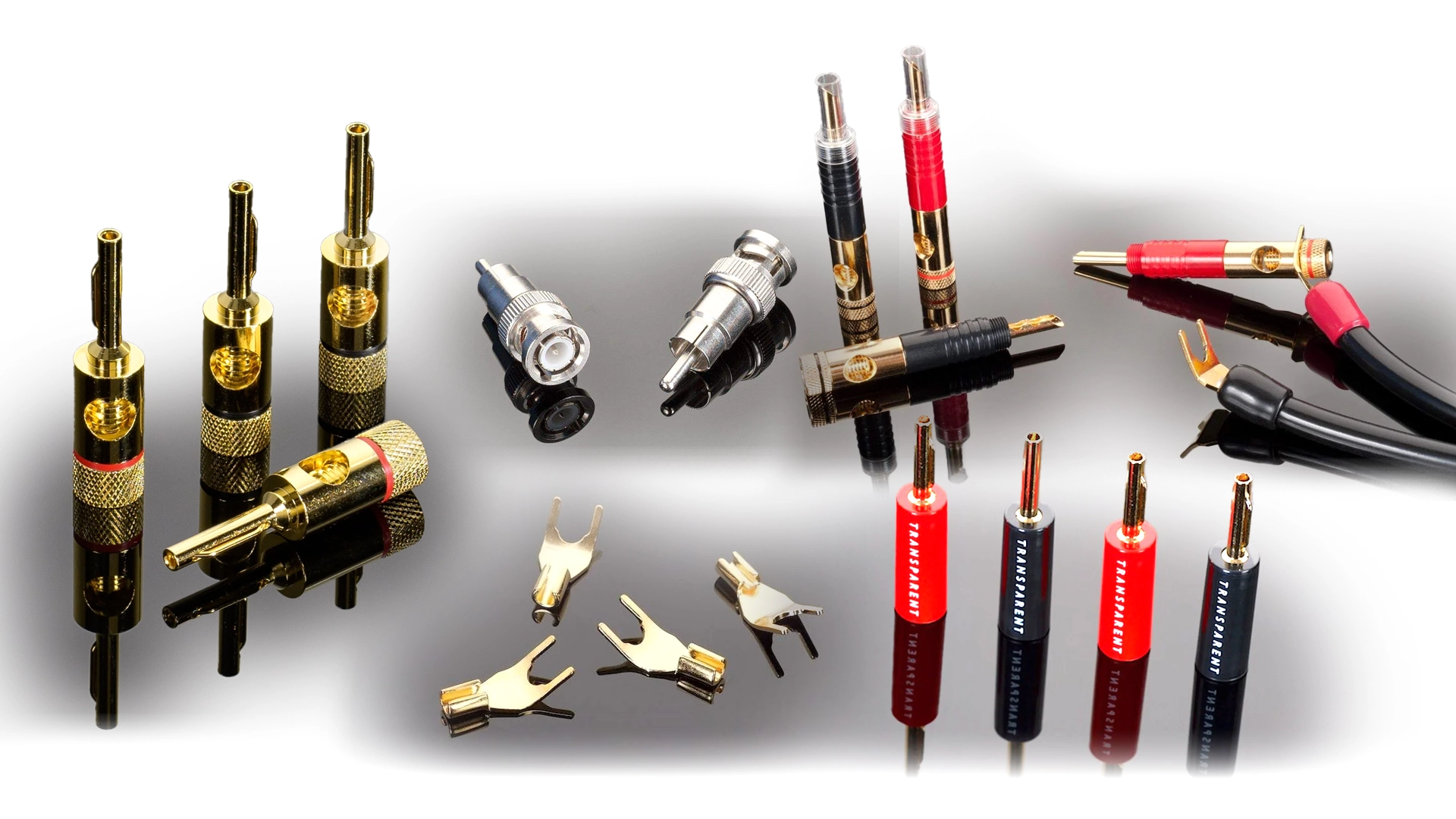
Transparent Audio is an American cable manufacturer founded in 1980 by Karen Sumner, Jack Sumner and Carl Smith. The company first worked in high-end distribution; Transparent Audio in the form listeners recognise today took shape in 1993, when the team introduced its own networked audio cables. Both dates matter: 1980 is the foundation of the company, while 1993 marks the distinct cable technology and product identity.
Transparent’s characteristic network modules are designed for the electrical behaviour of a specific cable type and length, with the stated goal of controlling noise and preserving consistent transfer across the audio band. They are not interchangeable decorative boxes. Speaker cables, analogue interconnects, digital cables and power products are developed in ascending families including Plus, Super, Ultra, Reference, XL, Opus and Magnum Opus. At higher levels, networks can be calibrated to the electrical characteristics of the owner’s components and system.
The company manufactures and tests products in Maine and supports an established upgrade programme, allowing qualifying owners to move upward without discarding the full value of an earlier cable. Cable audibility and network explanations are debated subjects, so results should be judged in the intended system rather than presented as universal fact. Transparent’s historical importance is nevertheless clear. It made the externally networked cable a recognisable high-end category and has refined that architecture for more than three decades under the same founding team, with unusually systematic matching, documentation and long-term customer support.
Van Den Hul

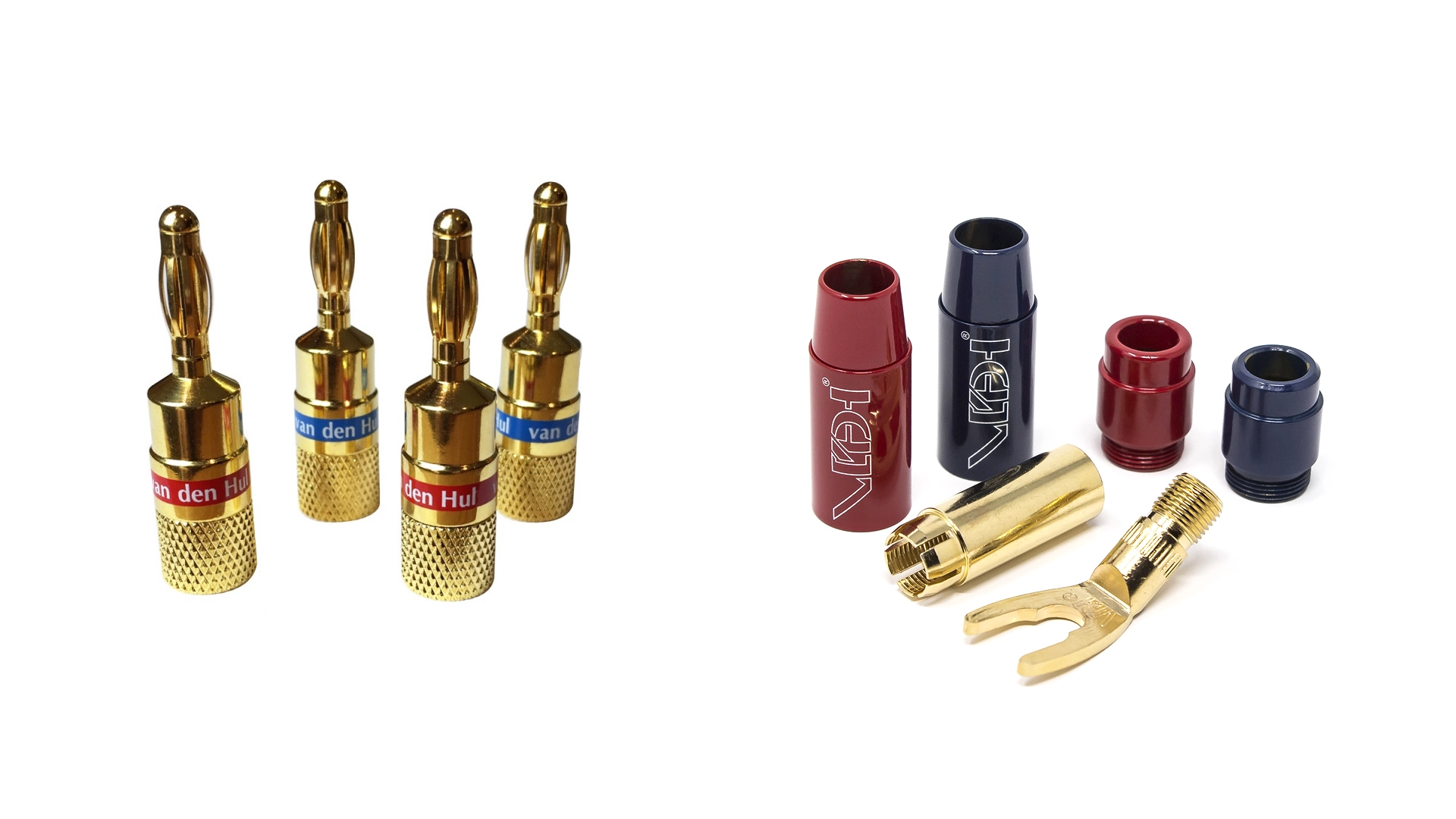
Van den Hul is a Dutch specialist whose identity spans three demanding parts of analogue playback: moving-coil cartridges, signal cables and the electronics that connect them. Aalt Jouk van den Hul founded the company in 1980 after years of cartridge repair and stylus research, and his name remains inseparable from the firm’s phono work. The Van den Hul stylus profile, developed to improve groove contact while reducing wear, led naturally to complete cartridges. Grasshopper established the marque internationally; Colibri, Condor, Crimson, Canary and Frog continue a range in which many units are built or serviced by hand. Cable development followed the same concern for preserving very small signals. Van den Hul introduced Linear Structured Carbon and used it in The First, presented as the first interconnect whose conductors contain no metal. The Second and The Third extended that carbon-conductor idea, while Hybrid designs combine carbon layers with proprietary metal conductors such as Fusion Technology alloys. The catalogue now includes interconnects, loudspeaker, digital and power cables, phono accessories, cartridge transformers and electronics including The Grail phono stages. Production is concentrated in Western Europe and the company also supplies materials and cables to professional and industrial users. What makes Van den Hul unusual is not one fashionable material but the continuity between groove geometry, microscopic cartridge signals and the conductors expected to carry them without adding a recognisable signature.
Viablue

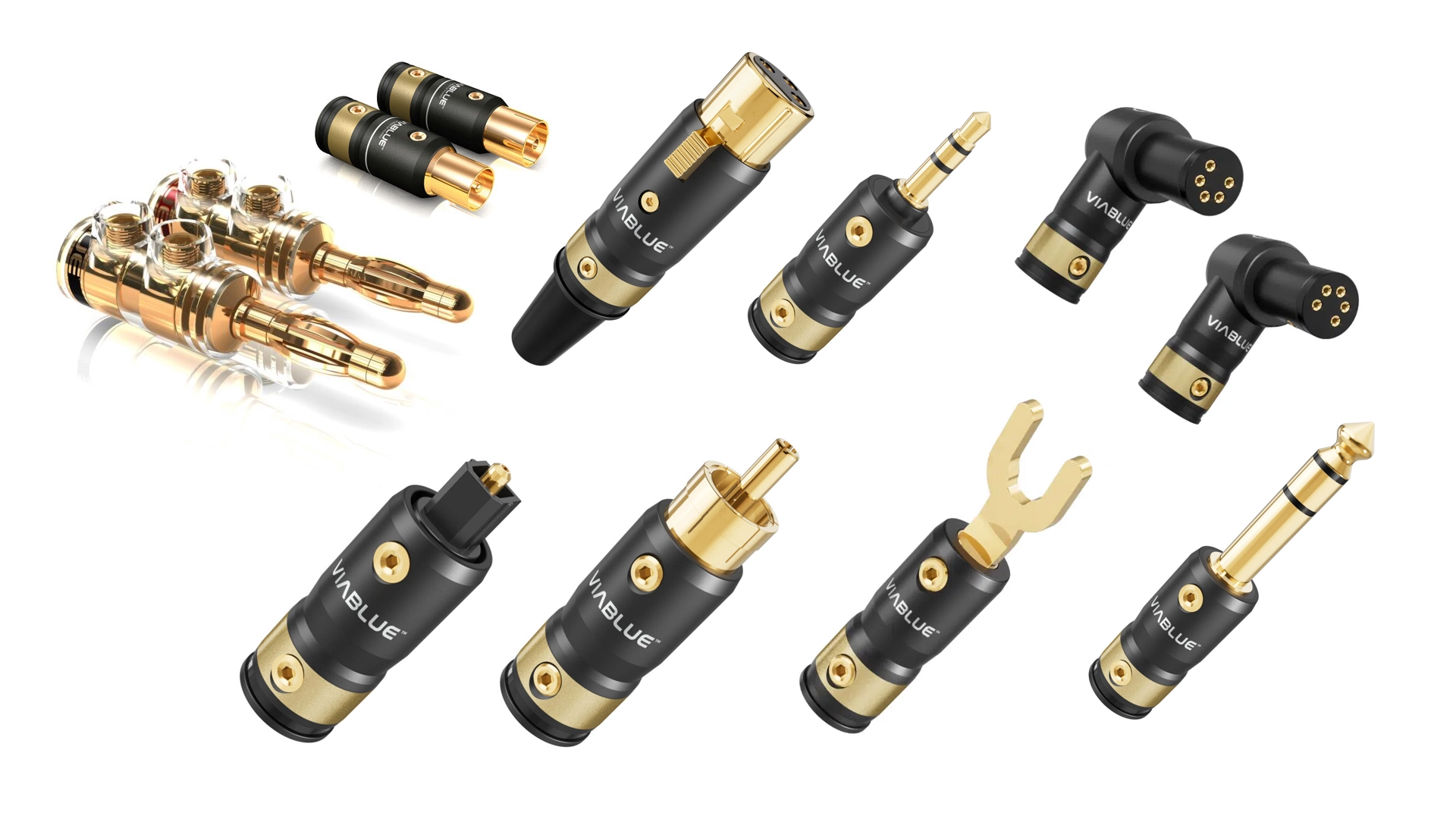
VIABLUE is a German manufacturer of cables, connectors and resonance-control accessories whose products are engineered and assembled as complete interfaces rather than as bulk wire with decorative plugs. Established in 2001, the company develops its range in Malsch and performs cable assembly by hand in Germany. Its catalogue covers analogue RCA and XLR interconnects, phono cables, loudspeaker and subwoofer cables, USB, Ethernet, optical and coaxial digital connections, as well as mains products and installation cable. Silver-plated oxygen-free copper strands, multiple shields and carefully separated conductor groups recur across the range. VIABLUE AIR technology uses air-filled tubes to reduce dielectric contact around critical conductors, while current SC-6 AIR and NF-S6 AIR products show how the company carries this principle into speaker and line-level applications. Connectors are treated as their own engineering family. T6s and T8 plugs use substantial full-metal housings, strain relief and interchangeable contact formats, allowing factory-finished cables and custom assemblies to share a consistent mechanical interface. The brand also makes braided sleeves, splitters and ferrules for installers, plus UFO absorbers, Rocket cable lifters, QTC spikes and related accessories for equipment and loudspeakers. That breadth is useful because it reveals VIABLUE’s real strength: a system of compatible cable construction, termination and mechanical finishing produced to repeatable standards. The visual language is bold, but beneath it is a practical German manufacturing proposition—specialist materials, serviceable connectors and enough formats to wire an entire stereo, cinema or network-audio installation coherently.
WBT

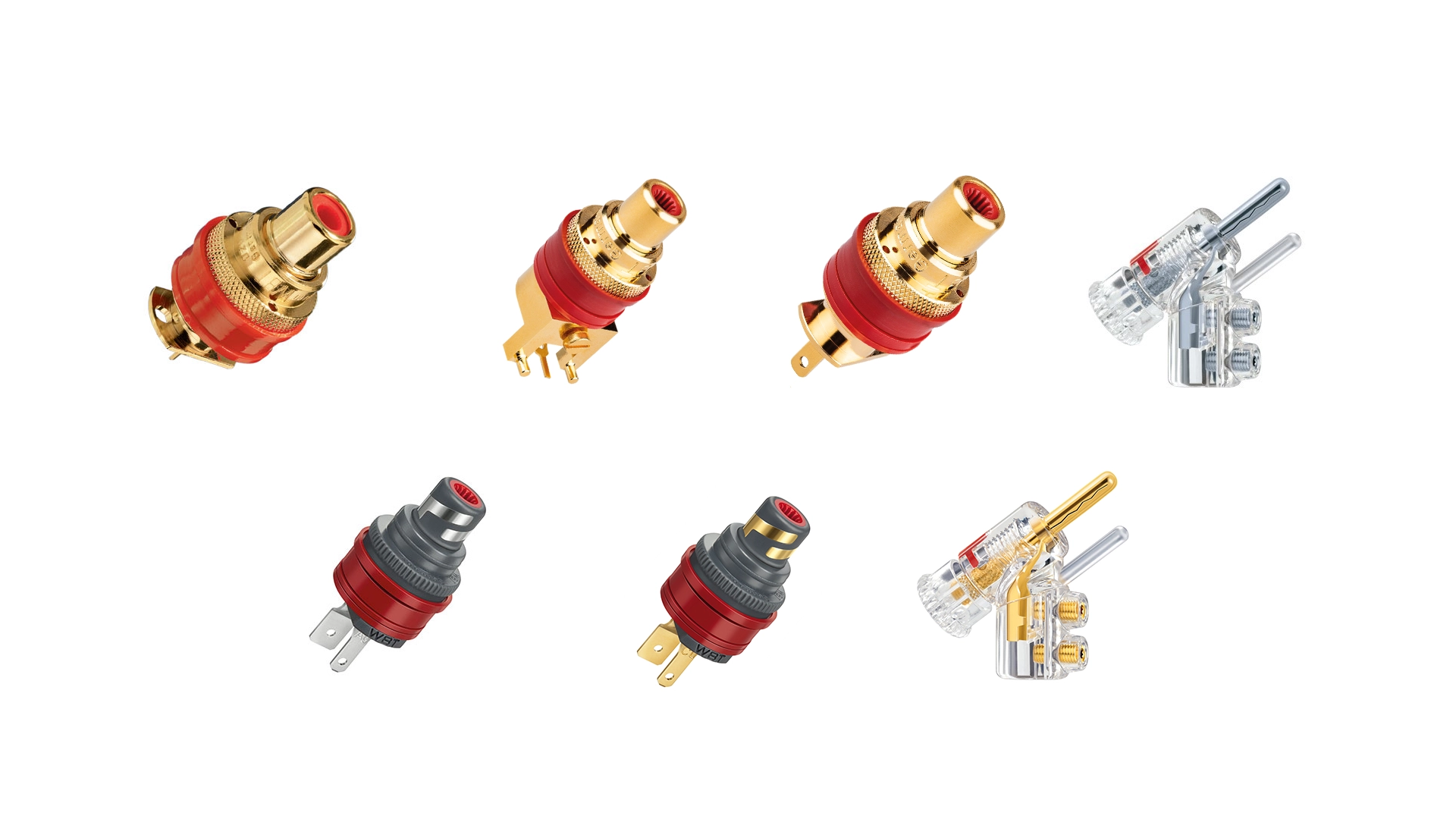
WBT is the German connector specialist founded in 1985 by Wolfgang B. Thörner. Its first important product, the WBT-0100 locking RCA plug, replaced the loose friction fit of a conventional phono connector with an adjustable collet mechanism that grips the socket securely without requiring excessive force. That attention to contact pressure, current capacity and long-term mechanical stability established the company’s role: not making complete audio electronics, but improving the small interface through which every signal and loudspeaker current must pass. WBT now produces RCA and true 75-ohm coaxial connectors, banana plugs, spades and equipment binding posts for manufacturers, cable companies and DIY builders. The nextgen range introduced a different construction philosophy. Instead of machining the whole body from a large mass of metal, it uses a minimal pure-copper or fine-silver signal conductor supported by a high-performance polymer. Reducing conductive mass is intended to limit eddy currents and parasitic storage, while the polymer carries mechanical loads and provides insulation. Contacts receive nickel-free gold, silver or platinum-based finishes according to the model, and many products carry safety approvals important to equipment manufacturers. Production and development remain in Essen. Thörner died in 2024, but the company continues the programme he established. WBT’s influence is easy to overlook because its name often appears on another brand’s rear panel; its achievement is turning the humble audio connector into a precisely specified, serviceable component with recognisable mechanical and electrical engineering.
Wireworld
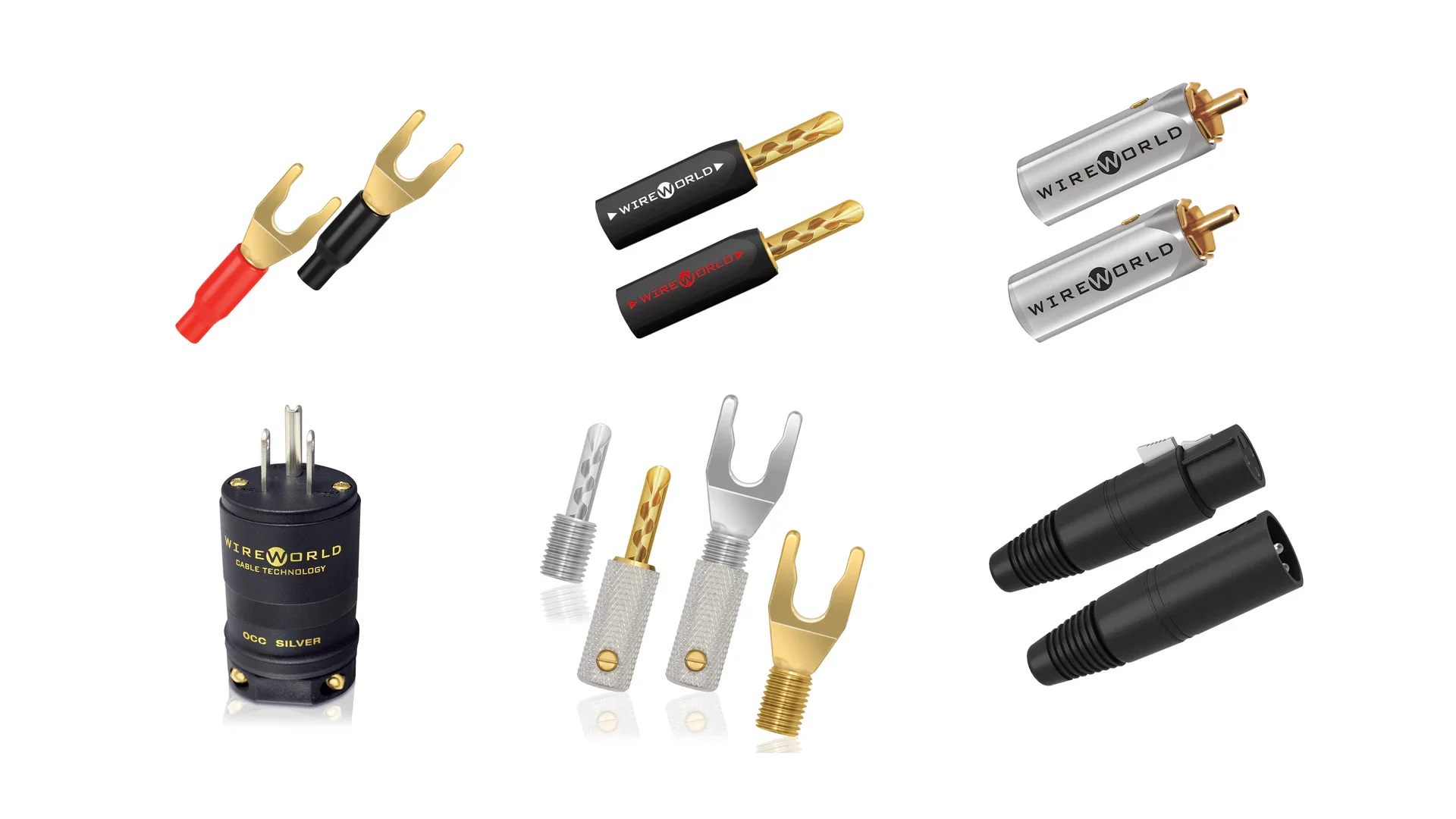
Wireworld Cable Technology is an American cable manufacturer founded in 1992 by industrial designer David Salz. Salz developed the company around comparative testing: a cable is evaluated against a direct connection with as little added conductor as possible, so the design target becomes preservation of the source rather than creation of a preferred tonal signature. Wireworld’s most recognisable construction is DNA Helix, in which flat conductor strands are arranged in parallel layers. The geometry is intended to keep electromagnetic paths consistent and reduce interaction among strands, while Composilex insulation was formulated to lower triboelectric and dielectric noise compared with common plastics. Those ideas are scaled through clearly differentiated ranges rather than reserved for one flagship. Solstice and Oasis provide accessible copper models; Equinox, Eclipse and Silver Eclipse add increasingly sophisticated geometries and silver-clad conductors; Platinum Eclipse uses solid silver at the top. The catalogue covers analogue interconnects, speaker cable, phono leads, power cords, Ethernet, USB, HDMI and specialist digital interfaces, each designed for the impedance and shielding demands of its application. Flat profiles and factory termination are practical consequences of the internal layout, not merely styling. Wireworld also publishes measured design information and maintains test facilities in Florida. The brand’s strength is a coherent engineering vocabulary carried across a very broad range: minimise electromagnetic loss, use low-noise insulation, preserve interface impedance and let direct bypass comparisons expose what the cable adds or removes.