
Portable Headphone Amplifiers Players
This category covers compact, battery-powered devices built for high-quality audio on the move. It includes all-in-one Digital Audio Players (DAPs), which store and play your hi-res music files, as well as portable headphone amps and DACs that connect to your smartphone to boost its sound quality. Their shared goal is to deliver a listening experience far superior to what a standard phone can offer alone. This guide lists the brands that specialize in high-fidelity personal audio for the listener on the go.
Hi-Fi brands in the category
Summary information and image
Direct links to official websites
Acoustune


Acoustune’s earphones are built around its Myrinx dynamic-driver diaphragm and a modular approach to the housing. Myrinx uses a thin polymer biomaterial, while the metal-body construction separates the driver’s acoustic chamber from the section carrying the cable connector. This separation is intended to limit interaction between the acoustic and mechanical parts of the earphone. Rather than defining its identity through ever-higher driver counts, Acoustune gives particular attention to diaphragm material and chamber construction. Established in 2013, the brand offers several earphone families, with interchangeable acoustic chambers available on selected designs.
ACTIVO


ACTIVO makes portable music players and earphones with an emphasis on straightforward everyday use. Its P1 player combines Astell&Kern’s TERATON ALPHA audio technology with a compact body, tactile playback buttons and support for lossless music streaming. The controls are shaped to be distinguished by touch, while the aluminium-and-polycarbonate construction is designed for a comfortable one-handed grip. These details show the brand’s focus on how a dedicated player fits into daily listening, alongside its audio circuitry. The catalogue also includes the earlier CT10 player and several earphone models, extending ACTIVO beyond a single portable source.
Astell & Kern


Astell&Kern builds dedicated portable music players that bring file playback, digital conversion and headphone amplification into one purpose-designed device. IRIVER launched the South Korean brand in 2012 with the AK100. Later AK models and the A&ultima, A&futura, A&norma and KANN families explored different balances of size, output capability and circuit complexity. The newer catalogue includes the PD series alongside flagship players. Distinctive machined enclosures and physical volume controls are part of the identity, but the range also reaches beyond players into headphone amplifiers, earphones and home-audio components. Collaborations with specialist IEM makers connect its source electronics with different approaches to personal listening.
Auris Audio


Auris Audio gives valve electronics a recognisable Serbian identity through hand assembly and extensive use of wood, leather and metalwork. Founder and CEO Milomir Trosic formally established the company in 2013 after years of designing amplifiers and other electronics. Integrated and power amplifiers form the core of the range, joined by preamplifiers, DACs, loudspeakers and a particularly strong headphone line. Headonia is the statement headphone amplifier, while Nirvana and the compact Euterpe address different headphones and system roles; Forte power amplifiers extend the same tube-led approach to loudspeakers. Transformers and power supplies are treated as fundamental parts of each circuit rather than hidden commodities. The result is a manufacturer defined by its own valve engineering and material craft, not simply retro styling.
Cayin


Cayin is one of the few large audio manufacturers to develop valve electronics for both full-size hi-fi systems and genuinely portable listening. Zhuhai Spark Electronic Equipment Co., Ltd. was founded in China in 1993 and markets its audio products under the Cayin name. Its home range spans single-ended 300B amplifiers, push-pull integrated amplifiers using valves such as EL34 and KT88, pre/power combinations, DACs and digital sources. Cayin later brought the same interest in tube operating modes and user-adjustable voicing to desktop headphone amplifiers and N-series digital audio players. Several products allow listeners to change output stage, feedback, bias or valve/solid-state timbre without replacing the component, making configurability part of the brand’s engineering rather than a software preset alone. Cayin also produces portable DAC/amplifiers and in-ear monitors. Broad in price and format, the catalogue links traditional transformer-coupled tube circuits with modern high-resolution digital and personal audio.
Chord Electronics

Chord Electronics combines aerospace-derived power-supply engineering with proprietary FPGA digital conversion, giving its amplifiers and DACs two distinct but connected technical lineages. Former avionics engineer John Franks founded the British company in 1989; its first amplifiers went to the BBC and were later used by studios including Abbey Road and Sony Music. Designer Rob Watts subsequently developed Chord’s digital architecture, implementing conversion, noise shaping and the long-tap WTA interpolation filter in programmable logic instead of an off-the-shelf DAC chip. That platform runs from portable Mojo and Hugo products through Qutest, Hugo TT and the reference DAVE, often paired with dedicated streamers or upscalers. Chord’s analogue range includes compact Table Top and Choral components as well as Ultima integrated, stereo and mono power amplifiers using the company’s dual-feed-forward topology. Machined aluminium cases and unusually compact forms are visually distinctive, but the real common thread is control over core circuitry rather than dependence on standard modules.
ESD Acoustic


ESD Acoustic is a Chinese ultra-high-end audio manufacturer whose project began in 2016 with David Dai and Jacky Dai. Early development drew on technology and guidance acquired from horn specialists Bruce Edgar and Sam Saye; the Hangzhou company followed in 2017. ESD’s signature is the complete field-coil horn system: externally energised drivers, large carbon-fibre horns and, in selected units, beryllium diaphragms are combined for high efficiency and wide dynamic range. Systems range from comparatively compact models to the immense Dragon and Super Dragon installations. ESD also makes the field-coil power supplies, active crossovers, Class A amplification and source components needed to operate them as an integrated chain. The scale is spectacular, but the important know-how lies in controlling magnetic fields, horn geometry, diaphragm behaviour and system alignment across many ways.
Eversolo


Eversolo is a Shenzhen digital-audio brand backed by Zidoo Technology and staffed by engineers working across decoding, analogue circuitry, amplification, system integration and user-interface design. Its early DAC-Z6 and DAC-Z8 established the visual language, but the DMP-A6 streamer made the name widely known by combining a large touchscreen, local SSD storage, network services, high-resolution conversion and preamplifier functions in one compact chassis. The range has since expanded through DMP-A8 and DMP-A10 streamers, T-series transports, DACs, power amplifiers and the Play streaming amplifier. Eversolo’s real strength is integrated hardware and software: library management, control apps, digital processing, clocking, conversion and analogue outputs are developed as one user-facing system rather than assembled as unrelated functions. It is a modern digital front-end specialist, not an old loudspeaker or amplifier marque.
FiiO


FiiO was founded in Guangzhou in 2007 and helped move serious personal audio from improvised accessories into complete, affordable systems. Early E-series portable headphone amplifiers built its reputation; the X3 player in 2013 made high-resolution playback central to the brand, and today’s Android-based M-series players combine local storage, streaming services, balanced outputs and replaceable or carefully engineered amplification stages. The broader catalogue now includes K-series desktop DAC/headphone amplifiers, BTR Bluetooth receivers, portable dongles, IEMs, full-size headphones and desktop source components. FiiO develops electronics, firmware, apps and transducers rather than depending on one fashionable product category, while sub-brand Snowsky explores smaller and more playful designs. Its distinctive strength is vertical product integration at attainable prices: a listener can build a portable, desktop or living-room chain whose interfaces and power requirements were designed to work together.
Graham Slee

Graham Slee is a British audio-electronics specialist best known for extracting low-level signals from cartridges without turning the phono stage into a feature-heavy control centre. Graham Slee, an electronics designer active professionally since 1974, established Graham Slee Projects in 1998. The catalogue ranges from the compact Gram Amp through Era Gold, Reflex and Accession phono stages, with the Elevator EXP providing active step-up for moving-coil cartridges. It also includes Solo and Ultra-Linear headphone amplifiers, the Majestic DAC/preamplifier, Proprius mono power amplifiers and purpose-designed interconnects. Several products use separate outboard power supplies, and the company documents loading, equalisation and circuit behaviour in unusual depth. Units are designed and hand-built in Britain, with long production runs and upgrade paths valued over frequent cosmetic replacement.
Hiby


HiBy began in China in 2011 as a software and firmware specialist for portable audio, years before its own digital players became widely known. That background still explains the brand better than any single product: HiBy develops the playback environment as well as the hardware, including HiByMusic, HiByOS, system-level audio processing and control software used across its own devices and by other manufacturers. The R-series players made the company a direct hardware brand, while the RS models introduced its Darwin architecture for configurable R-2R conversion. HiBy now covers digital audio players, USB DAC and headphone-amplifier dongles, Bluetooth devices and earphones, with features such as MSEB sound adjustment linking the products to its software roots. Its particular strength is vertical integration in portable hi-fi—interface, operating system, decoding, DSP and analogue output are developed as parts of one user experience.
HiFiMAN


HiFiMAN is one of the companies most responsible for bringing planar-magnetic headphones back into mainstream high-end audio. Dr Fang Bian started Head-Direct in New York in 2005 and adopted the HiFiMAN name in 2007; early products such as the HM-801 portable player and HE-5 headphone established both its digital and transducer ambitions. The core range now runs from accessible models such as Sundara through Ananda, Arya and HE1000 to the flagship Susvara. Across these families, very thin planar diaphragms, distributed conductor traces and increasingly acoustically transparent magnet structures are used to reduce moving mass and obstruction; the company describes later versions as Stealth Magnet designs. HiFiMAN also produces DAC/headphone amplifiers, R-2R portable players and in-ear monitors. Its real significance is the scale at which it has developed planar technology—from attainable everyday models to uncompromised reference designs.
iFi audio


iFi audio is the British specialist that brought serious DAC and headphone-amplifier engineering into genuinely portable and desktop formats. Launched in 2012 as a sister brand to Abbingdon Music Research, iFi develops its products from its headquarters in Southport, UK. The ZEN range made compact DACs, headphone amplifiers, phono stages and streamers easy to combine, while the hip-dac, GO and xDSD families address phones, laptops, Bluetooth listening and travel. Many designs use Burr-Brown conversion, balanced or symmetrical analogue stages and practical proprietary functions such as XBass, XSpace and iEMatch rather than relying on specification-sheet features alone. At the upper end, the Pro and iCAN products explore more elaborate power supplies and amplification; the SilentPower line tackles USB, network and mains noise around the system. iFi’s strength is the breadth of problems it solves without abandoning small enclosures or approachable system building.
Jade Audio


Jade Audio is FiiO’s value-focused personal-audio brand, created in China in 2018 to carry proven engineering into simpler, more accessible products. Its point is not to imitate FiiO’s entire catalogue at a lower price, but to concentrate spending on the parts that directly affect listening: transducers, acoustic loading, DAC and amplifier stages, useful connectivity and dependable construction. The range has included JD-series in-ear monitors, JT-series full-size headphones and compact KA-series USB DAC/headphone amplifiers, giving newcomers a practical path from a phone’s basic output to wired hi-res listening. Models are often sold through direct online channels and supplied with fewer luxury extras, which helps keep prices controlled. The unusual name comes from the Chinese expression translated as “sound of jade,” but the real distinction is more concrete: Jade Audio borrows FiiO’s experience in portable audio while maintaining a deliberately lean product brief. It is therefore best understood as an entry point into enthusiast headphones and IEMs, not as a separate maker of unrelated lifestyle electronics.
King Sound


King Sound, also presented as King’s Audio, is a Hong Kong specialist best known for making electrostatic loudspeakers and headphones accessible in several sizes. An electrostatic panel moves an extremely light diaphragm suspended between charged stators, giving the brand a route to low moving mass and rapid transient response that differs fundamentally from conventional cone drivers. The company has used this principle in full-height models such as King and King III, smaller Prince variants and later KS-series designs. Some loudspeakers combine electrostatic panels with dynamic bass sections, so the range should not be reduced to the inaccurate claim that every model is a crossover-free full-range panel. King Sound has also produced matching high-voltage energisers, headphone amplifiers and electrostatic headphones, allowing the same expertise to serve personal listening. Product availability and naming have varied by market, but the technical identity is consistent: complete electrostatic playback systems built by a rare Asian manufacturer with experience in both room and headphone formats.
Lotoo


Lotoo is the professional-audio brand of Beijing Infomedia Electronic Technology, founded in China in 1999. Its consumer reputation comes from portable digital audio players, but the underlying experience is in broadcast automation, location recording and professional recorders rather than lifestyle electronics. The PAW family translates that background into robust players with fast, purpose-built firmware, extensive file-format support, low-noise analogue stages and unusually detailed equalisation tools. PAW Gold and PAW Gold Touch established the flagship line; PAW 6000 and compact PAW-series DAC/headphone products bring the same operating philosophy to smaller systems. The transportable Mjölnir expands the idea into a powerful all-in-one source with battery operation, multiple digital and analogue connections and headphone outputs capable of driving demanding loads. Lotoo generally avoids an Android-style open application environment, using its own tightly controlled operating system to prioritise boot speed, stability and audio processing. Parametric EQ and ATE sound-shaping presets offer precise adjustment without replacing the recorded file. The previous 2015 date describes the period when Lotoo became widely visible to international portable-audio buyers, not the company’s 1999 foundation.
ONIX


ONIX is a British-origin audio name associated with the compact OA21 integrated amplifier and a minimalist, performance-first approach to electronics. The contemporary range shown on the listed site is developed in close association with Shanling and revives familiar ONIX visual cues—black acrylic, gold details and substantial power supplies—in modern digital and analogue components. Public accounts from the current distributor and from the separate British OA21/ONIX operation conflict over the exact start date, founders and trademark history, so assigning a single founding year here would create false certainty. The present flagship is Miracle, a modular stack that separates streamer, DAC, power supplies and headphone amplification into compact matching chassis. OC93 combines CD replay and network streaming, while OIA92 is a high-current integrated amplifier built around a large UI transformer and a dual-mono output section; ONIX-branded portable players, DACs and headphone products extend the name into personal audio. This should not be presented as an uninterrupted factory history from one owner. It is more accurate to distinguish the classic British amplifier legacy from the current Shanling-associated product programme while recognising that both use the ONIX name. The enduring thread is compact, visually restrained hardware with serious power or digital architecture rather than a broad lifestyle-electronics catalogue.
Questyle Audio


Questyle Audio was founded in Shenzhen in 2012 by engineer Jason Wang. Its identity is built around one circuit approach rather than a generic catalogue of DACs: patented Current Mode Amplification. In a current-mode stage the signal is processed as current through a very low-impedance node, allowing extremely high bandwidth and fast feedback when implemented correctly. Questyle uses the topology in discrete Class A modules, often four per channel in fully balanced desktop products, with the aim of achieving low distortion and stable control of headphones. The CMA family made the technology visible in combined DAC, preamplifier and headphone-amplifier components. CMA Twelve and CMA Fifteen became reference models; CMA Fifteen pairs four current-mode modules with an ESS ES9038PRO converter and can operate as a headphone amplifier, DAC or variable-output preamplifier. Newer CMA18 models continue the desktop line. QP1R and QP2R portable players brought the same amplifier idea to battery-powered listening, while M12, M15 and M15i dongle DAC/amps made it practical with phones and laptops. NHB earphones extend the mobile ecosystem through direct digital connections on supported devices. Product specifications and supported codecs vary by generation, so the brand should not be reduced to a claim that every model is wireless or handles every format. The important point is consistency: Questyle repeatedly redesigns complete source-and-amplifier products around its high-bandwidth current-mode stage, from a pocket dongle to a balanced desktop hub. The founding year has been added only because the 2012 date and Jason Wang’s role are consistently documented; the earlier text had left it blank.
Shanling


Shanling is a Chinese audio manufacturer founded in 1988, when it developed and released its first stereo amplifier. The company subsequently built CD, HDCD and SACD players, valve-output disc players, tuners, amplifiers and power products, acquiring the manufacturing depth that later distinguished it from brands created solely for the portable-audio boom. The CD-T100 helped Shanling enter international markets, while its M3 of 2014 was the first portable high-resolution player and opened the most visible chapter of the modern range. M-series digital audio players now span tiny entry models to Android flagships, with Shanling’s own MTouch interface used where a lighter operating system is preferable. The miniature M0 became especially influential by combining touchscreen control, high-resolution playback and two-way Bluetooth in a genuinely pocketable body. Portable DAC/headphone amplifiers in the UA and H families, Bluetooth receivers, desktop DACs, streamers and the revived EC/CD lines extend the digital source chain; ME and MG earphones give the company control over the final transducer as well. Shanling regularly works with established DAC, amplifier and Bluetooth platforms, but implements them through its own circuit layouts, clocking, power supplies, firmware and precisely machined aluminium cases. Its Shenzhen offices and Dongguan factory combine R&D, metalwork, assembly and sales, while licences and certifications have included LDAC, Hi-Res Audio, HDCD, Dolby, DTS, DVD and SACD technologies over the firm’s history. Shanling’s strength is continuity across formats: it understands optical discs, desktop hi-fi, wireless links and battery-powered players, so its portable products are not isolated gadgets but compact expressions of a much broader audio-engineering practice.
Sony


Sony helped shape both personal listening and home entertainment, from the Walkman and Compact Disc era to televisions, headphones and cinema systems. Masaru Ibuka and Akio Morita established the company in Tokyo in 1946 as Tokyo Tsushin Kogyo; the Sony name became its corporate identity in 1958. Tape recorders and transistor radios provided early foundations, but the 1979 TPS-L2 Walkman changed how people carried music with them. The CDP-101 followed in 1982, and the compact D-50 portable CD player in 1984 helped bring digital discs beyond the living room. Sony also played a central role with Philips in developing the Compact Disc and later SACD formats. Its hi-fi history includes ES amplifiers and disc players, while Walkman continued into digital music players. Headphones became another major field, spanning studio use, dedicated home listening and wireless noise-cancelling models. In video, the progression from Trinitron to BRAVIA televisions sits alongside home-cinema projectors and professional imaging equipment. Soundbars, receivers and disc players connect these audio and video interests within domestic systems. Sony’s scale matters because it works across recording, signal processing, playback hardware and entertainment production, with technologies moving between those areas. The consumer brand therefore encompasses far more than its professional AV division: it includes several of the products and formats through which generations of listeners first encountered recorded music and film.
Topping


TOPPING is a Chinese desktop-audio manufacturer founded in 2008, recognised for DACs, headphone amplifiers and compact power amplifiers whose measured performance is treated as a primary design target. The company helped shift expectations in affordable digital audio: low noise, low distortion, balanced connections and transparent volume control no longer had to be reserved for physically large or expensive components.
Products such as the D90 DAC and A90 headphone amplifier established TOPPING at the upper end of desktop hi-fi, while E-series DACs, L-series headphone amplifiers and DX combination units cover more accessible systems. The company has also expanded into PA-series power amplifiers, B-series monoblocks and discrete or resistor-ladder conversion. Proprietary NFCA amplifier modules are used to obtain high feedback accuracy, very low output impedance and useful power across a wide range of headphones. Flagship models add sophisticated preamplifier, remote and digital-interface functions without abandoning measurement discipline.
TOPPING’s strength is not that every new model posts another record figure. It is the consistent use of audio analysers, documented specifications and compact circuit integration to make performance predictable. Firmware, user interface and system matching still matter, and a technically excellent device is not automatically the right product for every listener. Yet the brand’s influence is clear: it forced a broad part of the market to explain noise and distortion with evidence. TOPPING now spans entry-level desktop systems and serious separates, but its identity remains unusually focused on engineering results per unit of space and cost.
Waversa Systems

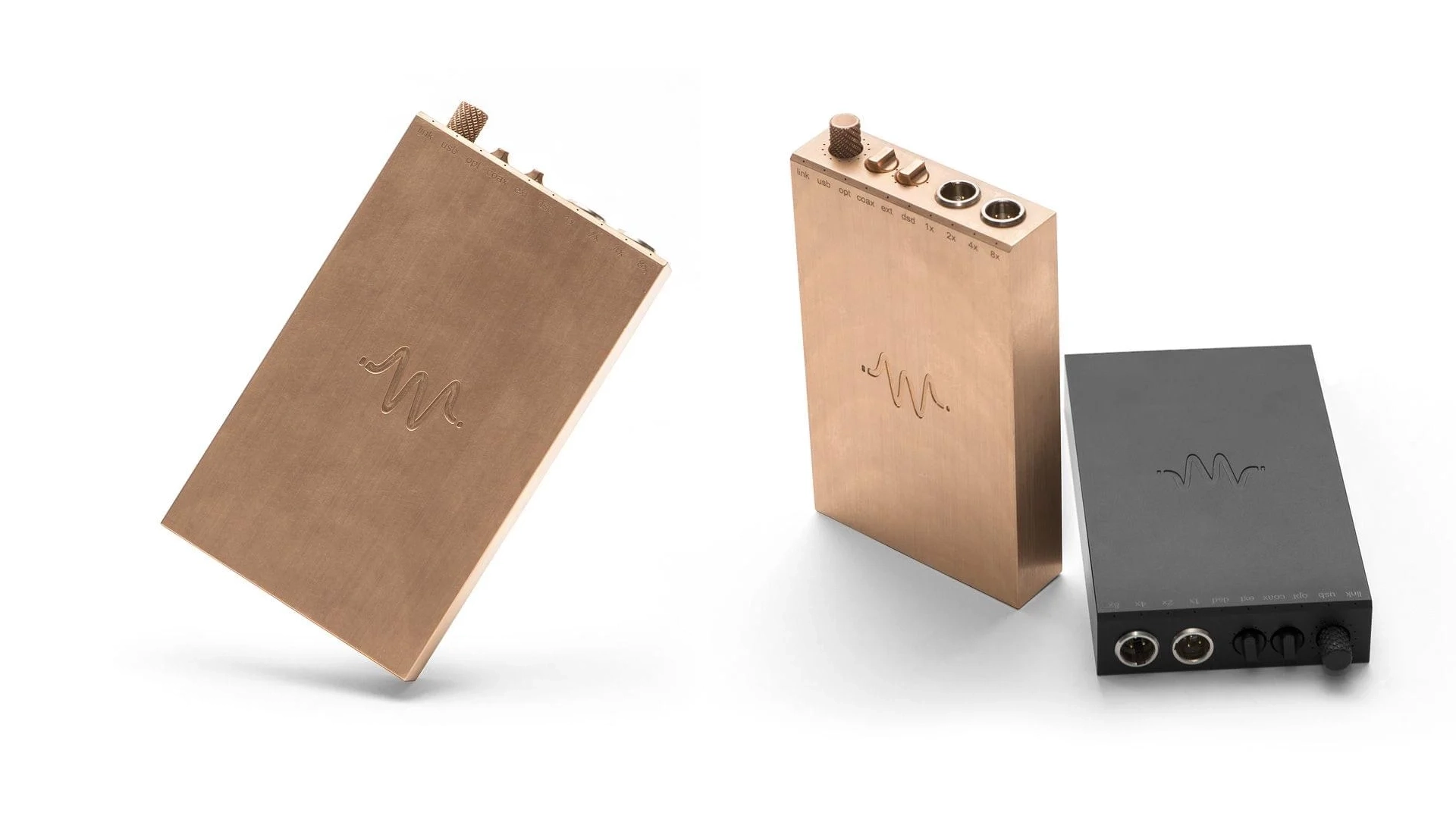
Waversa Systems is a South Korean digital-audio company founded in 2012 by engineer Dr Collin Shin. Before entering high-end audio, Shin worked on semiconductor and system design, experience that shaped a catalogue unusually focused on the behaviour of data, clocks, networks and power inside a complete replay chain. The company announced its WAP—Waversa Audio Processor—platform in 2013 and later developed WNDR, Waversa Network Direct Rendering, as a proprietary route for delivering audio over a network with tighter control of timing and processing. These technologies appear across network players, DACs, servers and hubs rather than belonging to one showcase product. The range spans compact WMini components, WStreamer bridges, WDAC converters, WCore servers and WRouter or WSmartHub network products, as well as integrated players, amplifiers, phono stages and the reference WV series. Waversa also makes Ethernet and USB filters because it treats electrical noise entering through digital connections as part of the source design. Product names and formats vary widely, but the unifying objective is consistent: minimise jitter and unwanted processing, isolate noisy subsystems and preserve the signal through conversion and amplification. Waversa’s distinctiveness lies in approaching a hi-fi system as a networked electronic architecture, not a stack of unrelated boxes. Hardware, FPGA or processor code and control software are developed together in Korea, giving the brand a coherent technical vocabulary that extends from an inexpensive interface filter to its largest source and amplification components.